
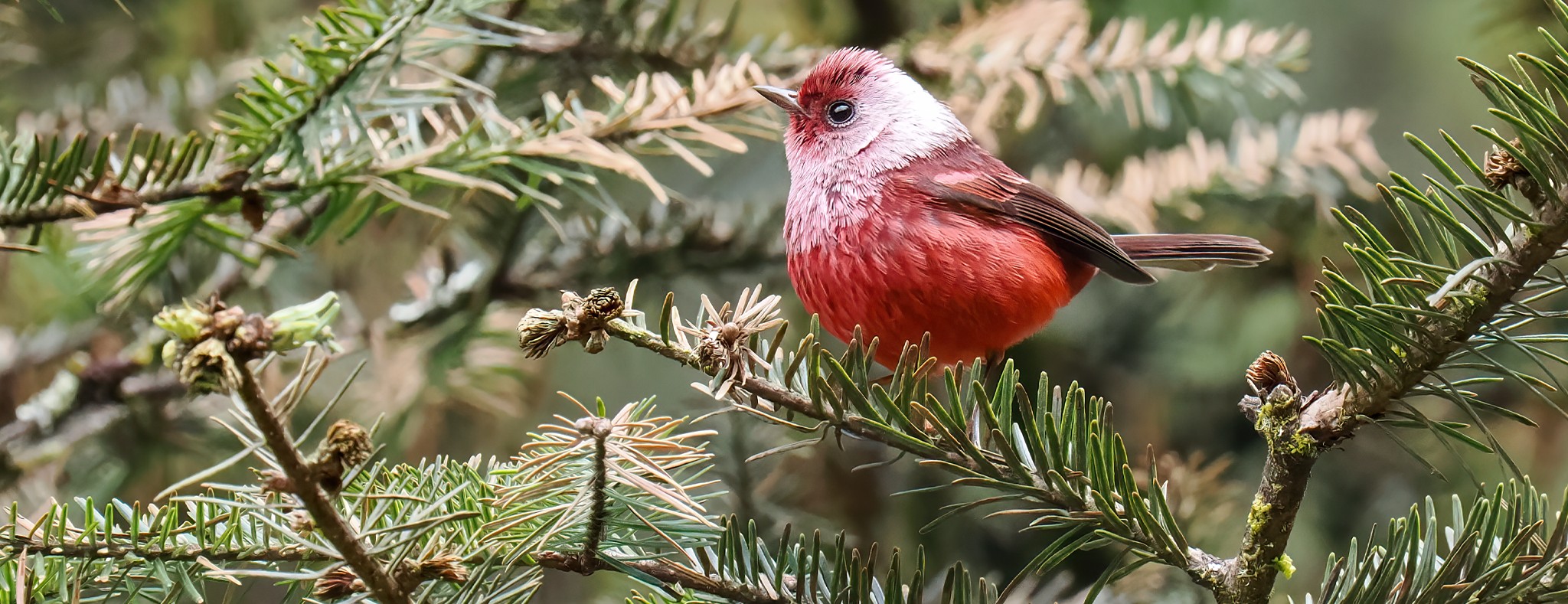
Guatemala is fast becoming the next ‘must-visit’ country in Central America. The country borders Mexico to the north, thus giving the opportunity to see a range of bird species which cover the gap from Mexican specialities and sough after Central American species. It is also a hotspot for overwintering North American birds – at the time of year we visit, these birds will mostly be in their spring, breeding finery. This fairly intensive tour will take you to a variety of habitats, including mountain forest, dry, Paramo-type grassland, subtropical humid forest on the Pacific Coast and tropical rainforest in the north of the country. We will also spend time in Tikal National Park to wonder at the breathtaking Mayan Temples.
The first half of the tour focusses on a series of natural parks in a wide circle of Guatemala City. Sought-after species we will look for include Pink-headed Warbler, Resplendent Quetzal – Guatemala’s National Bird (and currency) – Guatemalan Flicker, Rufous Sabrewing, the goldmani race of Yellow-rumped Warbler, Ocellated Quail, Wine-throated and Garnet-throated Hummingbirds, Mexican Whip-poor-will, the endemic race of Savannah Sparrow and the range-restricted, highly sought after Horned Guan.
At Los Tarrales, we explore the extensive grounds of a reserve in a coffee plantation for Azure-rumped Tanager White-bellied Chachalaca, Northern Potoo, Long-tailed Manakin and Slender Sheartail. On a series of – optional – hikes up forested volcanoes, we search again for Horned Guan, Mountain Trogon and Resplendent Quetzal again, among a wide range of species.
We then head north to the Peten region of Guatemala. Here, we stay at a wonderful Biological Station helping to protect Scarlet Macaws from the illegal bird cage trade. Several boat trips along wonderful rivers and channels, as well as walks along forest trails will provide us with the chance of seeing a wide range of species including Scarlet Macaw, Wedge-tailed Sabrewing, Yucatan Woodpecker, Yucatan Flycatcher, Agami Heron, Spot-tailed Nightjar and a host of egrets and herons.
Finally, we end the tour at two Mayan archaeological sites where we combine some serious birding with some must-see UNESCO Heritage Sites: the famous temples at Tikal and Yaxha. Special birds here may include Orange-breasted Falcon, Ocellated Turkey, Great Curassow, several species of trogon, Montazuma Oropendola and many more.
This tour to Guatemala is a perfect blend of history and birds with a decent scattering of mammals thrown in for good measure. Please read the tour report from March 2026 for further details of what to expect. Your tour leader for this Central American adventure will be Ashley Saunders, assisted throughout by local guides.
DAY ONE: Welcome to Antigua – Guatemala!
Fly UK/Guatemala via Madrid (avoiding USA), departing London Heathrow early morning and arriving in Guatemala late afternoon.
We will be met at Guatemala City airport by our local guide for the trip and our driver for most of the tour. There might even be enough light to add our first bird species to the tour list while at the airport! A 90 minute drive will take us to the old capital city of Guatemala (and UNESCO World Heritage Site) of Antigua. We will stay at one of the lovely old hotels in the centre of the city
DAY TWO: Our first proper birding.
An early start will find us traversing the cobbled street of the quaint town before driving to San Cristobal el Alto; a drive taking us uphill with the backdrop of volcanoes in the distance.
Roadside stops along the forested road should produce many new species for us, including tanagers, warblers, Grey Silky-flycatchers, Ferruginous Pygmy Owl, orioles and hummingbirds. After getting some birding under our belts, we will head for breakfast in a local breakfast on the hillside; again with the backdrop of volcanoes.
Our next stop is about 30 minutes away, where we will visit El Pilar Farm and its hummingbird feeders. Azure-crowned, Berylline, Green-throated Mountaingem, White-eared, and Rivoli’s Hummingbirds and Rufous and Violet Sabrewings may all be seen here. A trail leads through the forest, where we may find Golden-crowned Warbler, Bar-winged Oriole, Hooded Grosbeak, Elegant Euphonia among others (keeping one eye on the sky for soaring raptors as the temperature begins to rise).
We return to Antigua, where lunch will be taken on a balcony in a city centre restaurant in order to admire the volcanoes surrounding the city. The afternoon can be spent on a cultural walk around the city – where there will also be some bird activity to look out for – exploring Central Park, the main cathedral, La Calle del Arco, etc. or spent at leisure. Barn Owls nest in one of the ruins, while Vaux’s Swifts, Yellow-winged Tanagers, Northern Rough-winged Swallows and Great-tailed Grackles might be seen in the vicinity.
After a bit of downtime, dinner will be at a local restaurant in the city.
DAY THREE: In the pink?
We set off from Antigua early and make a hour drive to Tecpan. We stop at a rest area in a Pine Oak forest for a filling breakfast in a roadside diner. The car park may produce our first Pink-headed Warbler of the trip, as well as coronata race Steller’s Jay, Band-backed Wren, Crescent-chested Warbler, Brown-backed Solitaire. After breakfast we will take a stroll in the forest behind the diner, hoping for another chance of the previous species, as well as Guatemalan Flicker, overwintering American warblers, Mexican Violetear, Blue-and-white Mockingbird and Golden-crowned Warbler, etc.
We set off from Tecpan around mid-morning and spend the rest of the day driving to Huehuetenango. We will stop for lunch (probably at the aptly-named town of Quiche) and there should be time for a leg-stretch to look for some dry-scrub species such as Lesser Roadrunner along the journey.
Arriving in Huehuetenango early evening, there should be time for a bit of a freshen up before dinner in the hotel.
DAY FOUR: from the Valley of Death to Heaven’s Door
We will have an early coffee in the hotel before collecting our picnic breakfast boxes. We will drive to Todos Santos, a small village about a ninety minute drive from the hotel. Here, we will meet a local guide at his house, where we will have breakfast and another strong coffee! The local guide will accompany us into a unique habitat, which combines sub-alpine meadows, rocky areas and slow-growing vegetation due to climatic conditions and altitude (3,850 meters). It is one of the geologically oldest areas and has the highest mountain formations of Central America. This is one of the areas with the greatest biological diversity and endemism in the country, where a number of endangered species of flora and fauna can be seen. It is possible there will be an early morning frost on the ground as we make our way to the first stop.
An rocky area of bushes and grassland should provide us with views of (Goldman’s) Yellow-rumped Warbler – a gorgeous distinct subspecies, which will surely be split soon? – Yellow-eyed Junco, Spotted Towhee, etc. Moving further into the valley, the view opens out to a paramo-type, golden grassland where we hope to find Ocellated Quail, the endemic race of Savannah Sparrow, gorgeous Eastern Meadowlarks and maybe a raptor or two. Small patches of trees may hold Black-capped Siskin, more ‘Goldman’s’ Warblers and Broad-tailed Hummingbird.
Our final stop will be on a mountain road, where we should get outstanding views of Pink-headed Warblers, overwintering American warblers including Black-and-white, Tennessee, Townsend’s, etc. Lunch will be at a local restaurant to Todos Santos.
The afternoon will be spent driving to the city of Quetzaltenango. After checking in and relaxing – our hotel will have naturally-heated baths – followed by dinner at the hotel, there will be an optional night excursion. A short drive will take us to the access road to Fuentes Georginas, we will try and see Mexican Whip-poor-will and Fulvous Owl before returning to the hotel.
DAY FIVE: At the spa
Depending on our success or otherwise of last night, we may return to the access road of Fuentes Georginas to listen to the dawn chorus and to try and see owls and Poor-wills again. The dawn chorus on the humid subtropical slope is usually spectacular. As the owls and Poor-wills switch off, guans, thrushes, solitaires and warblers take over. As light creeps over the distant volcano, we will scan the trees on the hill for a very special, range-restricted bird: Horned Guan. As well as birds, we will take time to see the sulphury steam coming from the rocks by the road: we are definitely in a volcanic area!
When the Fuentes Georginas reserve opens, we will enter and have breakfast at the café. Tourists will also be showing up and heading for the spa baths. There may be time for us to participate, too! The forest around the baths is an excellent place to see Horned Guan, Mountain Thrush, Blue-throated Motmot, and many species of butterfly.
After the spa reserve, we head for our next destination. We stop for lunch at a delightful restaurant, which is also a superb place for birds. There’s a mixed colony of herons and egrets right next to the dining area, where we should see Boat-billed Heron, Great and Snowy Egrets, Tricoloured and Green Herons, Ringed Kingfisher, orioles, Green Iguanas, etc. It will be hard to tear ourselves away!
We reach Los Tarrales Nature Reserve between mid to late afternoon. We may be tempted to stop at a local ice cream farm along the way! Los Tarrales is a wonderful lodge, rising from 615 to 2,600m. The reserve is critically essential for protecting several endangered species, notably Horned Guan and Azure-rumped Tanager. The diversity of ecosystems creates a natural haven for wildlife enthusiasts, researchers, and eco-tourists.
The rest of the day can be spent exploring the grounds around the main dining and bar areas, where you might see Lesson’s Motmot, White-bellied Chachalaca, Yellow-winged Tanager, Golden-fronted Woodpecker, Cinnamon Hummingbird and Central American Agouti on the lawns.
Dinner will be taken at the lodge in the communal dining room.
DAY SIX: exploring Los Tarrales
After a coffee in the dining room, this morning will be spent exploring Los Tarrales. Vehicles will take us into the heart of the reserve, where we will be looking for tanagers (including Azure-rumped Tanager) parrots and parakeets, Emerald-chinned Hummingbird, raptors, woodpeckers and a host of different species. Breakfast will be a picnic style overlooking a hillside for perched and soaring raptors, with another chance of finding Horned Guan on the wooded hills. We may take one or two short strolls along estate tracks to find feeding flocks of warblers and vireos. We return to the lodge for lunch.
After a rest, we will explore the grounds further by foot. Lesson’s Motmot should be seen well, but our main target will be feeding flocks to sift through. American wood warblers, kingbirds and flycatchers should be in evidence as they feed up before heading north. We may visit a delightful lagoon on the estate, too; an area which also attracts many birds such as Northern Bentbill, Rufous-capped Warbler, various raptors and we may be lucky to locate the regular Northern Potoo if it’s at home.
After a siesta or further exploring, dinner is at the lodge.
DAY SEVEN: Lake Atitlan
After breakfast we will explore an area of the Los Tarrales reserve we haven’t yet visited to look for species we may have missed so far. These may include Long-tailed Manakin, Rufous-backed Wren and various hummingbirds and tanagers, etc.
We have to leave Los Tarrales after lunch. A short drive brings us to a small reserve on the banks of Lake Atitlan. The narrow paths around the hot, dry reserve give us a good chance of catching up with a range-restricted hummingbird called Slender Sheartail. The dry scrub may be also be home to passage migrants such as MacGillivray’s Warbler, Hutton’s Vireo, etc.
We check in at our next hotel in the afternoon, which looks out over Lake Atitlan (but we won’t see the extinct Atitlan Grebe, unfortunately). The afternoon is at leisure; free to stroll the hotel grounds down to the lake. Wildfowl may include Blue-winged Teal and Lesser Scaup, while the tiny reedbed can host Soras, sparrows and finches. Perching posts around the boat moorings are attractive to flycatchers and roosting egrets.
Dinner is served in the restaurant overlooking the lake.
DAY EIGHT: a bit of a hike
The reason for the relaxing afternoon yesterday becomes obvious this morning! A short drive from our hotel brings us to the base of Volcan Atitlan just before dawn (we will have breakfast boxes with us). We may be lucky and find Whiskered Screech and Northern Pygmy Owls as dawn rises.
We enter a trail that ascends the volcano: a famous site for Horned Guan. The lower slope is an easy walk, with plenty of birds to look for. Rusty Sparrow, Chestnut-sided Shrike Vireo, Mountain Trogon, Northern Emerald Toucanet, Flame-coloured Tanager, etc. may all be in amongst feeding flocks. As we climb, we will listen out for Horned Guans calling and ‘singing’ and home in on any we do hear. We will also be listening for Resplendent Quetzal and Azure-rumped Tanager (see also the birds listed for Day 9) . This is a strenuous walk: people who may not be able to make it to the top may still wish to do some birding around the lower slope. We return to the lodge in the afternoon, where some people may wish to use the swimming pool after the morning’s exertions!
DAY NINE: a Resplendent day?
Another day, another early morning walk on steep hillside paths in subtropical humid forest. A 5.30am start followed by a twenty-minute drive will see us parking up before dawn above a hillside famous for its resident Resplendent Quetzals (again, we will have breakfast boxes with us). The Park is called Rey Tepepul, and birders and general tourists come here to set off along the narrow trail in the dark.
Crested and Highland Guans will be calling in the gloom as we make our way down the hillside. We will be keeping an ear open for the call of the quetzals along the whole route. When we, or one of the other groups hears a male call, we will home in on the bird to try and get good views. If we are lucky, one or two quetzals will have found a fruiting tree close to the main trail where they often show well.
The trail in the forest if a 5km loop, which we hope to complete while looking for birds. As well as the iconic Resplendent Quetzals, other species found here include Blue-crowned Chlorophonia, Azured-rumped Tanager, Slender Sheartail, Bar-winged Oriole, Elegant Euphonia, Northern Emerald Toucanet, Chestnut-sided shrike-vireo, white-eared Ground Sparrow, Green-throated Mountaingem, Rusty Sparrow, Black Hawk-Eagle and overwintering American wood warblers. We return to the lodge in plenty of time to pack before our midday transfer to the airport for our internal flight to Flores.
We transfer to our Flores hotel on the shores of Lake Peten Itza for the start of the next part of our adventure.
DAY TEN: Las Guacamayas Biological Station
We leave our hotel in Flores after breakfast, when we drive around the lake shore to a boat dock called Paso Caballos. Along the way, we pass through marshland, grassland, ranching country and dry scrub. An impressive bird list is possible before we even reach the river at Paso Caballos.
Marshy areas should produce sightings of Snail Kite, American Purple Gallinule, Northern Jacana, several species of wader, egrets, herons and wildfowl. Grassland areas along the route are usually full of species such as Vermilion and Fork-tailed Flycatchers, Indigo Bunting, Bronzed Cowbirds and Grassquits. Raptors may include Roadside Hawk, Bat Falcon, American Kestrel, Laughing Falcon and Aplomado Falcon.
Bushes and trees along the way may be full of passage migrants such as Parula, Tennessee, Black-and-white and Magnolia Warblers. In short, anything might be found before we reach our boat on the San Pedro River!
We transfer to a boat for a short ride to the Biological Station. Mangrove Swallows should be with us throughout the whole journey, as well as herons, egrets and flycatchers. We dock at what several people have described as ‘paradise’: a lodge on the banks of the river with extensive grounds to explore and hummingbird feeders near the reception!
Following lunch (at approximately 3.00pm), there will be an opportunity to be guided along trails ending at a lookout point. Alternatively, people may wish to relax by the feeders to get good views of Wedge-tailed Sabrewing, Green-breasted Mango, White-bellied Emerald, Rufous-tailed Hummingbird and even Yucatan Black Squirrel.
At about 4.00pm, as the heat and humidity die down a bit, we will head out onto the river again. We will explore several channels where we might find species such as Sungrebe, Wood Stork, Plumbeous Kite, Night Herons, Yellow-tailed Oriole, Yucatan Flycatcher, Yucatan Woodpecker and maybe even Agami Heron. We will return to the lodge for dinner.
After dinner, for those that are still eager for more wildlife, there will be an opportunity to take a night boat ride along the river. Morelet’s Crocodiles are usually idly swimming in the water while we try and spotlight Northern Potoo and Spot-tailed Nightjar.
DAY ELEVEN: exploring the biological station
An early breakfast at the lodge is followed by another trip along the river. Dawn will accompany us on our travels as herons, egrets and raptors leave their roost sites. If there is an orange sunrise, it will provide some stunning photographic opportunities.
After a leisurely boat ride, we disembark on one of the Biological Station’s trails into the forest. Our main target will be Scarlet Macaw, or Las Guacamayas as the locals call them; named after their favourite tree – the Guacamayas tree!
There are plenty more species to look for, though. These may include all of the species seen yesterday afternoon as well as Grey-throated Chat, Green-backed Sparrow, Mayan Antthrush, White-bellied Wren, Keel-billed Toucan, Tody Motmot, Tropical Royal Flycatcher, Ornate Hawk Eagle, etc. We return to the lodge for lunch.
The afternoon is at leisure around the biological station before dinner in the dining area. If the evening boat trip didn’t happen last night, it will take place this evening.
DAY TWELVE: Las Guacamayas to Tikal
After breakfast at Las Guacamayas, we board our boat for the final time. It will take us back to Paso Caballos, where we board our vehicle(s) back to Flores through the farmland and mashes trying to see any birds we may have missed on the way in. We take lunch in the town of Flores before driving to Tikal, the famous UNESCO World Heritage Site.
After checking in at our lodge within the park, we’ll take a stroll around the area to see what birds we can find. Ocellated Turkey is usually easy to see, as are Russet-naped Wood Rail, Keel-billed Toucan and Montezuma Oropendola. There will be plenty of time to prepare for dinner at the hotel.
DAY THIRTEEN: Among the Ruins
After breakfast at the hotel, we will walk along the forested roads of Tikal National Park with a local guide. The park is huge, so we will pick the best routes for birds and temples on the complex. We may be lucky and glimpse a Northern Grey Fox or a Basilisk Lizard along the way.
The roads and trails are excellent places to see Slaty-tailed, Gartered and Black-headed Trogons, Mealy, White-fronted and White-crowned Amazons, woodcreepers, tyrannulets, warblers, woodpeckers and flycatchers. We may also find White-collared Manakin in the thick dry scrub.
The impressive ‘Temple 4’ will come into view; even more impressive is that there’s usually an Orange-breasted Falcon sat on the side of it! We hope to get good telescope views of this sough after Near Threatened species.
Taking our time, we will enter the Main Plaza where the famous Mayan Temple I and Temple II are situated. We will have plenty of time to take in the wonder of this ‘Bucket List’ site to absorb its history.
Lunch will be in Tikal’s main restaurant, followed by a slow stroll back to the hotel. If we haven’t seen them before, we may bump into White-nosed Coati, Central American Spider Monkey or Central American Black Howler Monkey.
The rest of the day is at leisure, so people will have the chance to swim, take a siesta or take another walk around the grounds before dinner in the hotel.
DAY FOURTEEN: More temples and birds
There will be chance for another walk around the grounds near our hotel at Tikal in the early morning, hopefully finding any species we didn’t see yesterday such as Great Curassow, Streak-throated Hummingbird, Ivory-billed Woodcreeper, etc). There may even be a chance to try and watch the sunrise from one of the temples this morning (not included). Lunch is at our Tikal hotel.
The afternoon will be spent transferring to, and exploring, another important archaeological site ninety minutes away from Tikal. Yaxha isn’t as famous as Tikal but was the third largest Mayan city from around AD 250-600. It was discovered in 1904.
Not only are there more Mayan temples to explore but there are further birding opportunities in the forested complex. There is a similar range of species to be found at Yaxha as there is at Tikal.
After lunch at Yaxha, it will be time to leave to catch our internal flight from Flores to Guatemala City. In the capital, we transfer to our comfortable hotel near the airport followed by dinner.
DAYS FIFTEEN AND SIXTEEN: homeward bound
After a leisurely buffet breakfast, we will transfer to the airport for our flights home. We arrive in the UK on Day 16.


