
Last week Nick and myself decided to make a last-minute dash for the West coast of Ireland in the hope of connecting with some epic seawatching and the first trans-Atlantic crossing of American shorebirds of the autumn. We had a 4-day window from 27th August and on the morning of 26th the chart for the west was looking decidedly encouraging. Normally our short autumn holiday’s away (we try to do one every year) have to be booked weeks or even months in advance around tour commitments but there is really no substitute for ‘going on the weather’ if at all possible. So Tuesday afternoon we booked a flight from Stansted to Cork, hired a car, found some digs and got an early night ready for a 4.30am start on Wednesday!
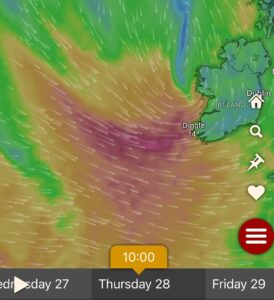 Left – a screengrab of the Windy App from Tuesday afternoon showing the picture for 10am on Thursday. A fast-moving low was racing across the Atlantic from the Southern tip of Greenland, bringing rain and strong westerly winds and making more or less a direct hit onto Ireland’s Dingle peninsula, County Kerry. The winds appeared to be pushing up into the coast of neighbouring Clare, and we figured large numbers of seabirds could be displaced into this area and then track back south once the front had passed…
WEDNESDAY 27TH AUGUST
After our (very!) early start we we at Stansted and on our way on the 0810 Ryanair flight and soon collecting our hire car in Cork. It was about 2.5hrs drive to get to Dingle, where we would be based for the next three nights. We drove into strong winds and increasingly heavy rain – a quick stop at Inch Strand showed us what we were in for – we could barely stand up or see never mind birdwatch! We got to the digs about 1.30pm, and made an executive decision to go to sleep for an hour – well we had been up early! The alarm went off at 3pm and the rain seemed to have stopped – perfect timing!
Neither of us had visited Kerry before but we were at least armed with plenty of ‘gen’ – mostly just place names of sites where rare birds had turned up in the past. The first of these was the east end of Smerwick cove at a spot called Baile an Reannaigh. Here a small stream feeds out across a stony beach and the shoreline attracts a number of small waders. The tide was up and there were about 150 Dunlin and Ringed Plover huddled among the pebbles, plus a juvenile Ruff looking slightly out of place. Ventry beach had more of the same , plus a few terns and gulls to look through. A fairly slow start but good to get to grips with a couple of local sites.
THURSDAY 28TH AUGUST
With the strong WSW wind and heavy squalls forecast we wanted to kick off with a seawatch this morning. Brandon Point, on the north side of the Dingle peninsula, would be our watchpoint of choice – the far more famous Bridge’s of Ross is on the next headland to the north, but being over 2hrs drive from us, we opted for it’s less-known cousin. Reached by crossing the dramatic Connor Pass from Dingle, we could see the headland standing proud in the distance but also the black and purple cloud masses out to the west, clearly headed in our direction! As we parked up at the seawatch point, one such storm hit us and so we stayed in the car until it passed. Opening the car window after it’s passing, we could see a Cory’s Shearwater cruising past in the Manx line just offshore and a flock of gulls in a tightly packed group – 23 Sabine’s Gulls!! This saw us leap out of the car, grab the scopes, and head down to the cliff to get set up!
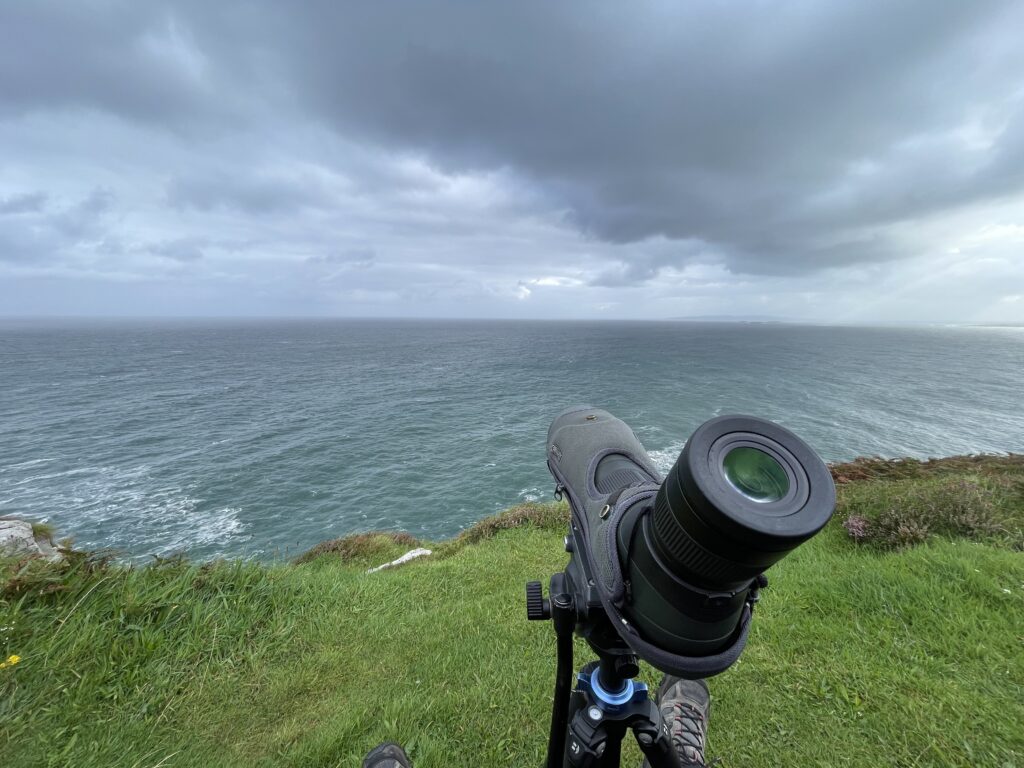
Our seawatching station on Brandon Point, looking north towards Loop Head
Our first morning of seawatching was nothing short of epic. Large shearwaters were piling through at a hell of a rate – by the end of our 4.5hr shift we estimated, using periodic timed counts, that about 1500 Cory’s and 1500 Great Shearwaters had gone through. Many were close enough inshore so that we could see the yellow bills on the Cory’s and check the underwing patterns on them for Scopoli’s (we didn’t see one!). But the star of the show was Sabine’s Gull – we logged 185, mostly adults still in full breeding plumage! There were a small number of juveniles which were most easily picked out by showing more pale on the head than the adults. They would come through in small flocks of 10-20 birds, normally pausing to land on the water for a while before continuing on. Pomarine Skuas numbered 8 (all full-spooned adults) and the supporting cast was 38 Sooty Shearwaters, 6 Arctic Skuas, 2 Great Skuas (a sign of the times), 12 Arctic Terns and 1 Kittiwake. There were, of course, petrels as well. The nearby Great Blasket Islands have some 50,000 pairs of European Storm Petrel so it was no surprise that we saw 21 of these tiny seabirds jinking through the wave-troughs in their usual fluttering manner. Being east coast birders we needed a bit of time to fully get our eye in with petrel flight patterns (the easiest way to identify them on a seawatch) but once we did, the larger and longer-winged Leach’s Petrel was easy to pick out. They always looked more like a large bat, with wings distinctly angled at the carpal and a brownish cast to the body plumage. Armed with these ‘search images’ then, once a Wilson’s Petrel finally glided into view the alarm bells rang immediately. Slightly larger than a Stormy but with a rounded leading edge to the wing lacking Leach’s carpals, the two birds we saw were both incredibly distinctive due to their preference for gliding. They would move through as if magnetically attracted to the sea surface, barely ever flapping and keeping their semi-circular wings held perfectly flat. They also showed a distinctly long-looking rear end, no doubt aided by their long projecting feet. The time had flown by and we only realised we had been sat for so long because of the discomfort caused by parking your backside on grassy rocks for 4.5hrs!
Now it was time to turn our attention to waders! We drove back over the pass to Dingle and after grabbing some supplies, headed back out west to check Trabeg, Ventry, Baile an Reannaigh and Ferriter’s Cove. We saw ore or less the same birds as yesterday with the addition of juveniles of Knot and Bar-tailed Godwit, and the Ruff now increased to two! At Ferriter’s though, we got briefly excited with the discovery of a stint on the kelp at the north side of the bay with a few Dunlin and Ringed Plovers. It looked pretty grey and interesting from a distance, but unfortunately once we worked our way into a closer position we could see the unmistakable features of a juv Little Stint – gingery edging to covert feathers, two sets of white braces on the back and a fine-tipped bill. At Trabeg the long-staying Laughing Gull eluded us, but again the tide was not in our favour.
FRIDAY 29TH AUGUST
The wind had switched slightly overnight to more of a WNW, meaning it would be a bit more exposed for our second session at Brandon Point. Noisy parties of Choughs were tumbling along the cliff edge in the wind and we saw a couple of Peregrines today too. Once again we were alone at our seawatch position (we had been joined in the latter stages of yesterday by a local, but seen only one other birder since we had been here so far – madness!) and it soon became apparent that birds were still moving. Sabine’s Gulls dropped today to a mere 46 (taking our overall total to 231 in 9hrs seawatching!) while Cory’s held their own at 1500 but Great’s reduced to only 34. The big change today was Long-tailed Skuas – we saw a whopping 17 with a nice mix of juveniles (intermediate and light morphs) and the rest seemingly adults which had lost/moulted their tails. The views were so close that the two white shaft streaks on the upperside of the outermost two primaries was easy to see. Their flight was so distinctive too – so lightly built and often stalling to dip feed or patter along the water like a petrel. We saw another cracking Wilson’s Petrel, gliding through in the close Manx line, and we also logged 13 Leach’s Petrels, 38 Storm Petrels, a Grey Phalarope, and another 46 Arctic Terns. One of the crazy moments was trying to share directions on an adult Long-tailed Skua – “there’s three Cory’s just passing it now, and oh, hang on, there’s a Leach’s behind it!”.

Dramatic coastal scenery at Brandon Point
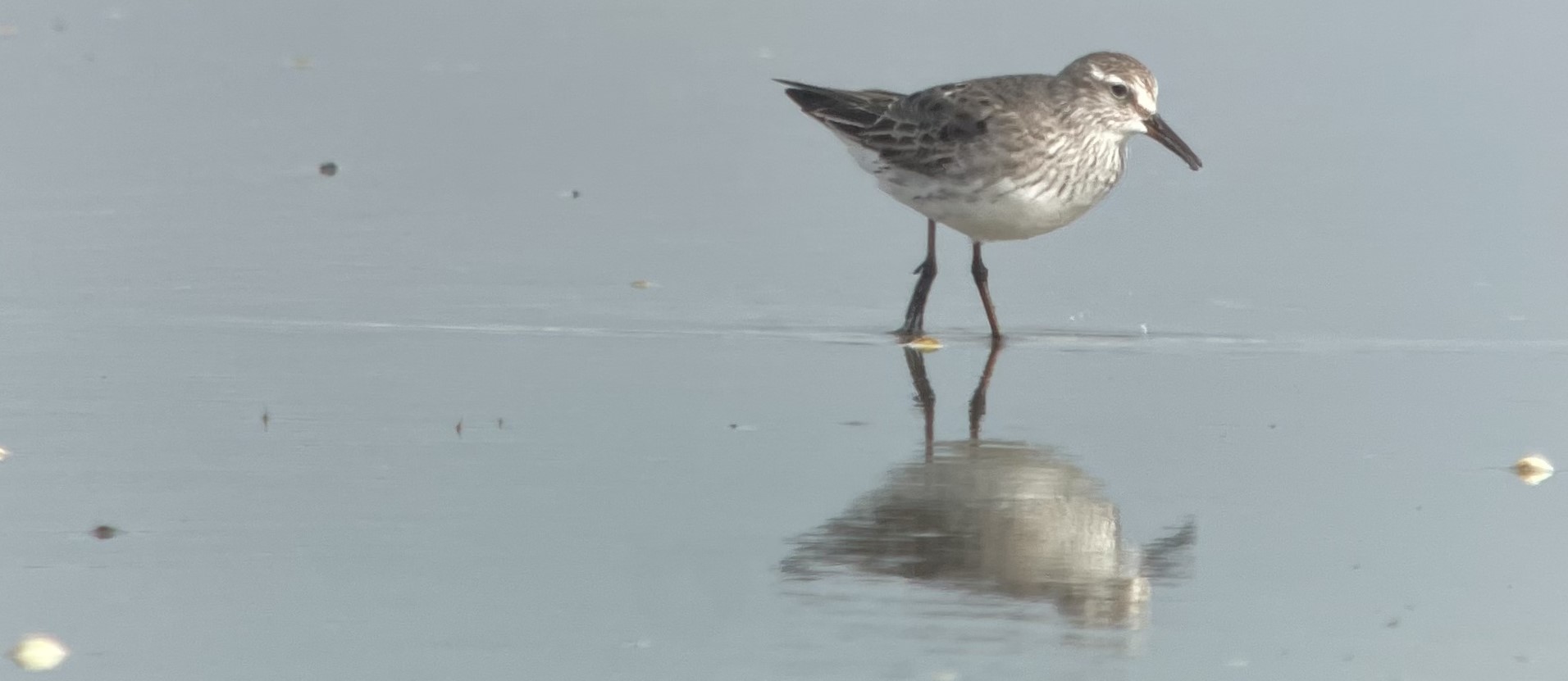
We knocked off a little bit earlier than yesterday as we felt that surely, the arrival of the front had dropped some American waders somewhere on the vast estuaries and sands of the county! Trabeg, near Tralee, is a huge area and we were on low tide, but still found some good flocks of Dunlin to work, saw a shed load of Greenshanks and a selection of other bits (there was an adult Ring-billed Gull about, but we didn’t see that). Looking at the map though there looked to be a smaller estuary a bit further north, called Carrahane Strand. We rolled the dice and drove up there, being greeted by sunshine. Typically for Ireland, these sites don’t have hides or boardwalks! So we put our wellies on and just walked out onto the mud! We were surrounded by a nice Dunlin flock, probably a couple of hundred birds strong, and it wasn’t long before the inevitable happened. Nick spotted an interesting small wader – it was distant against the sun but it had super long wings and could only be either a White-rumped or Baird’s. We tentatively ruled the latter out on body shape but knew we needed to see the bird closer. We took a gamble and just waded towards it – the Dunlin weren’t bothered and just carried on feeding oblivious to us. Sure enough, our bird was a lovely adult White-rumped Sandpiper, almost entirely moulted through to non-breeding plumage other than for one summer scapular!
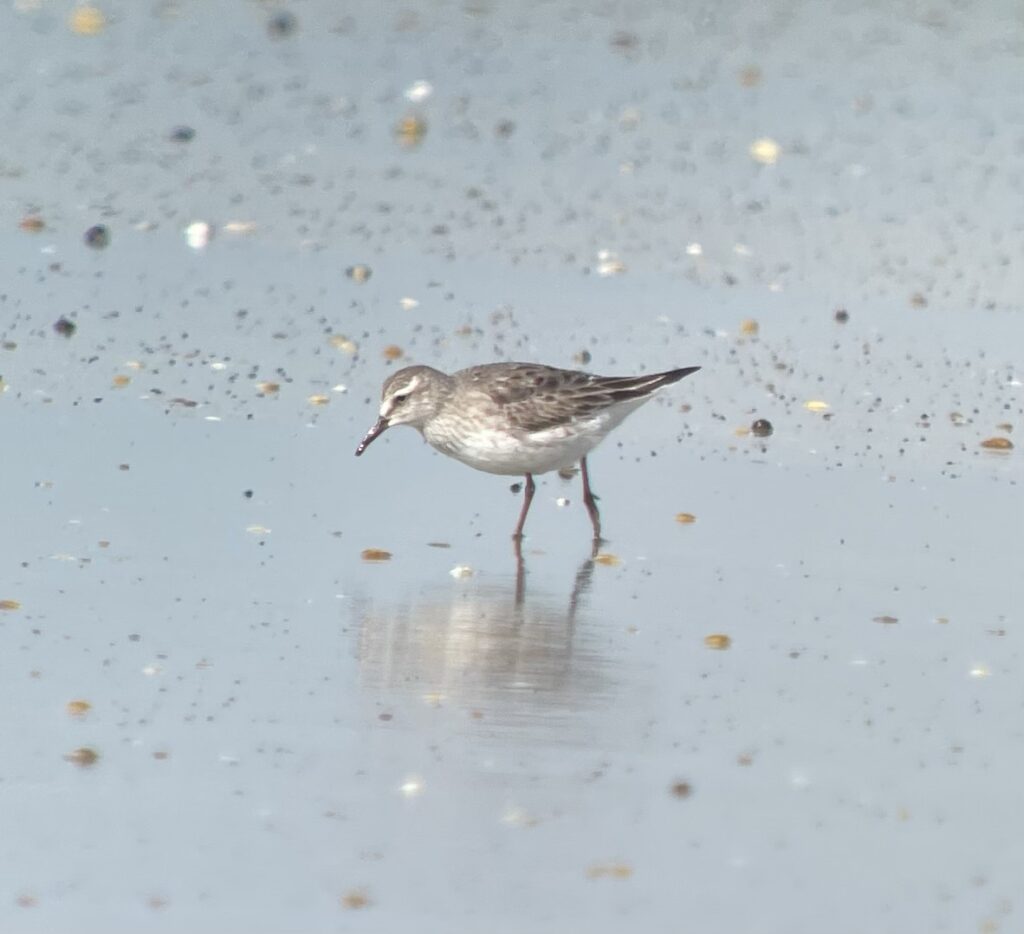

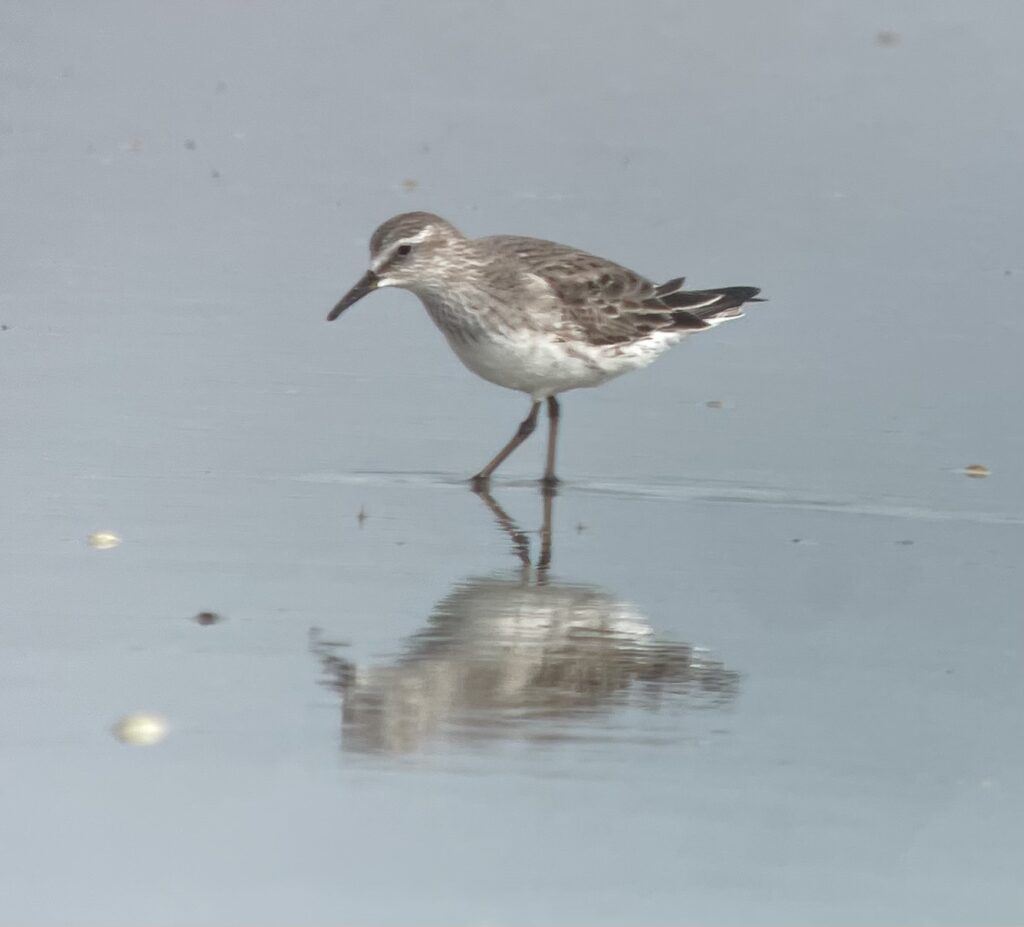

Adult White-rumped Sandpiper at Carrahane Strand
Time was racing away from us so we just opted to roll the dice and check one more site – Baile an Reannaigh had felt the ‘birdiest’ spot west of Dingle so far and so we headed there,, knowing really we only had half an hour to check it before it would be Guinness time! We arrived there just before 7pm and sat out another shower in the car. Scanning across through bins and a rainy windscreen, we saw an odd-sized wader standing next to a Whimbrel waaaay over the far side of the bay. I suggested Curlew Sand as it looked pale on the front but that didn’t really fit. We grabbed our scopes but could only see a Redshank – maybe we’d misjudged? I thought the previous bird had looked wrong for that on size and overall colour so scanned further left along the strand and picked it up – bloody hell that’s not a Redshank, it’s a Lesser Yellowlegs! We both took some poor photos and thankfully Nick somehow managed (given the distance) some impressively good vidoe. I turned to speak to a chap that came out of one of the houses, looked back in my scope and it had gone. Basically, neither of us saw it fly off and we never saw it again – it was on view for maybe 3-4 minutes in total!! Safe to say, the Guinness slipped down rather well after an epic days birdwatching.
SATURDAY 30TH AUGUST
Wind and rain – lots of it! Sadly our last morning was a total right-off – we managed to check Ferriter’s Cove and Baile an Reannaigh again, but it was pretty biblical weather and by about 1130 we had to leave anyway to start making our way back to Cork. Thanks Ireland – it had been a blast!!
IF YOU THINK THIS SOUNDS LIKE YOUR SORT OF BIRDING THEN GET IN TOUCH – WE ARE PLANNING A NEW TOUR TO KERRY AND CLARE FOR SEPTEMBER 2026, TO RUN CONSECUTIVELY WITH OUR WEXFORD & CORK TRIP. ENQUIRE NOW TO RESERVE A PLACE!
AJS, September 2025


