

SATURDAY 31ST MAY – Sunny spells and fresh South-westerly winds, 11C
Today was our final day exploring the Orkney Mainland before heading back south on the ferry. With light rain forecast to move in from the west, we decided to head to Marwick Head first on the west coast, to view the bustling seabird colony before the weather deteriorated. It actually remained fine for the hike up the cliffs and back and the wind wasn’t too strong, so the viewing conditions were pretty nice. We could see two huge flocks of Kittiwakes feeding just offshore from the clifftop, with both Arctic and Great Skua harassing them! The skua numbers have thankfully improved a lot this year compared to last, with both species being seen on every day of the trip and definitely more Bonxies around, hopefully a sign they are already starting to bounce back. There were some large rafts of Common Guillemots on the water too, but from the top, we would see many more, as this species is the most common nesting seabird on the ledges here. The sight and sound of any seabird colony is a real spectacle and again we were pleased to see that, while there were still lots of unoccupied ledges here, there were more birds than in the Birdflu-ravaged 2024. Razorbill, Fulmar and of course Puffin were here too, and we probably saw just into double figures of the latter.
Heading back down to the bay, we then drove all the way back across the islands to the East Mainland, and Deerness. With a South-east wind we figured it must be worth checking some migrant spots, not least because birds had arrived further north on Shetland. We drew a complete blank though at both Sandside and East Denwick, with very little to report from either location. In the afternoon we headed over to the Ring of Brodgar, so folk could have a walk around the standing stones. We were lucky here with an Osprey which flew in and started hovering over Loch of Harray next to the car park, providing a nice end to the trip. From here it was back to the Stromness ferry terminal for the ninety minute run down to Scrabster harbour, and then a 3hr drive all the way down to Boat of Garten for our final overnight.
FRIDAY 30TH MAY – Fine and sunny in light westerly winds, 15C
A beautiful, balmy day awaited for our final day on North Ronaldsay. With slack weather after the recent strong winds, we were hopeful that some migrants would drop but the day didn’t really pan out that way! We spent the morning checking a number of crofts with cover in the hope of unearthing something, centred around the south-east corner of the island. It was really lovely out and while the first couple of spots yielded nothing, we were enjoying the blue sky and turquoise seas. At Kirbest, we unexpectedly flushed a Snow Bunting along the road and up a driveway! The bird sadly didn’t seem that well – a young male bird different to yesterdays female on The Links. We watched it at close range feeding on the driveway and then left it be. After checking the Old Mill and another couple of spots down towards Bride’s Ness, we went through the gate in the sheep dyke and scanned the bay. Two Whimbrel flew off calling and there were sightings of Little Grebe and Reed Bunting among various other common waders and wildfowl noted. We then drove up to the surgery, and checked the garden there before heading down the track to Gravity. The small plantation held two Sedge Warblers which were no doubt breeding, but again no migrants could be found. After a quick look at Burray, we checked Ancum willows and with nothing much to show for the mornings efforts, we returned to the Obs for lunch.
For the afternoon we decided to sack off checking crofts and instead head up to the lighthouse and look for waders and seabirds. At Trolla Vatn 23 Bar-tailed Godwits were resting along with a few Turnstones and a single Dunlin. Walking up onto the top of the beach to view the bay, we saw several Black Guillemots and Eiders and by now were just happy to enjoy the beautiful t-shirt weather! We followed the stone dyke back to the communications mast and then walked out to the seawatch hide. Unlike in previous visits, there was no need to shelter inside the hide today and instead we scanned the sea from outside the hide. The view of Fair Isle was spectacular and offshore we watched a feeding frenzy of Arctic Terns and Kittiwakes. Eight Manx Shearwaters glided in and joined the throng and three Great Northern Divers included one really close full summer bird eating a crab. One of the Kittiwakes flew in and landed next to an adult Common Gull allowing for a rare and useful comparison of these two adult plumages side by side.

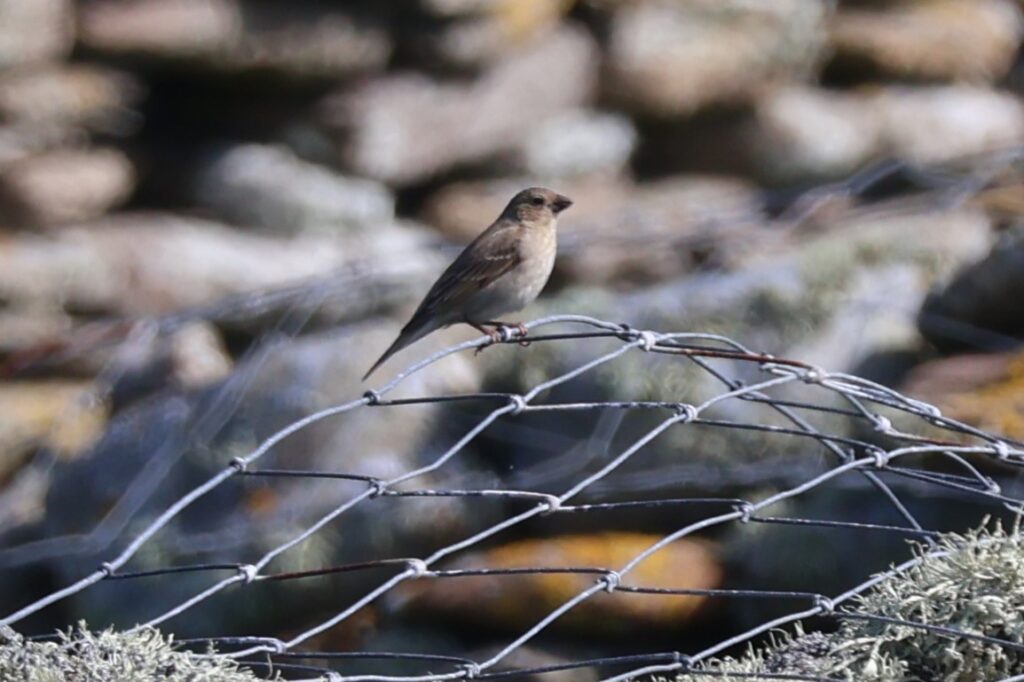
Common Rosefinch (female/imm male) at Bewan
After a quick look on Bewan loch, we jumped back in the van with a view to heading to Westness. We’d only driven a short way along the road when a brown passerine flew past the vehicle – stockier than a Linnet, very plain and quite long tailed, it looked a lot like a Rosefinch! Stopping the vehicle Ashley looked behind the van and could see the bird sat on the overhead wires with two Linnets, and it was indeed a brown female/immature male Common Rosefinch! We bailed out and the bird immediately flew down across the road but thankfully perched on the wire on top of the stone dyke and posed there in the sunshine long enough for everyone to see it. It dropped down into the grass but as we were grabbing a scope it perched up on the wire again and this time sat long enough for everyone to get a scope view of this scarce spring overshoot. Other than the Cuckoo we saw in the hand, this was the only landbird migrant we had seen in three days so it was particularly sweet that it had come just as we were about to leave! From here we returned to the Obs (noting a Chiffchaff near one of the traps) and organised our gear ready to head up to the airstrip for the 1800 flight back to Kirkwall.
THURSDAY 29TH MAY – Wet morning, dry afternoon in light easterly then NW wind, 10C
We rose early this morning for two hours birding before breakfast, hoping to maximise the (forecast!) clearer weather first thing. It was already spitting though as we left the Obs at 6am and headed up to the lighthouse area to check to see if any migrants had arrived. The wind was circulating around the eastern flank of a low pressure area, so we actually had an easterly but it was not originating from very far. There was, therefore, no migrants at all around the beacon and the crues along towards the seawatch hide. We checked Bewan and the stone dykes behind the communication mast, but basically saw little other than four Raven. We checked Ancum willows too with no joy, and the area around Senness and Garso. A Snipe perched on a wall was about the highlight, along with lots of Black Guillemots in the bay behind Senness.
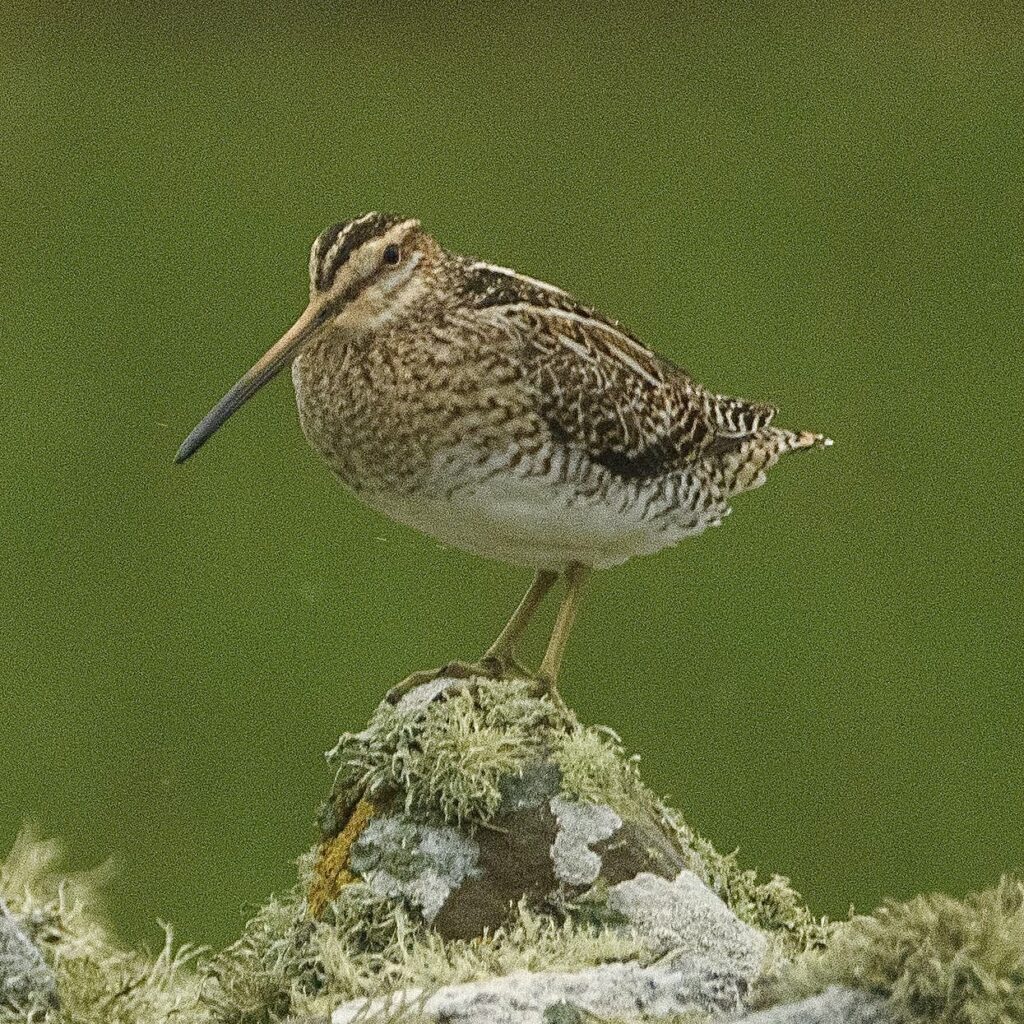
Common Snipe (Sonja Herz)
After breakfast we rather reluctantly headed back out – it was now tipping down! We decided the seawatch hide was probably the most sensible bet so we had an hour or so here enjoying the close-up comings and goings of the Black Guillemots. A Whimbrel flew by and offshore we noted three Manx Shearwater, four Puffin and several of the other common seabirds. Back at Ancum, the Red-necked Phalarope was still present and showing really well – the best views we had had of it so far.
It had been a tough morning, so we headed back to the Obs early to dry out and prepare for hopefully a drier session after lunch.

Snow Bunting
As forecast the rain had started to peter away by 2.30pm and we headed out to the central part of the island. After a walk through the Holland House gardens we parked at the post office and did a circular route around a number of crofts to check for migrants. Still nothing doing, but the Snipe were loving the light drizzle and we had several up drumming right over our heads, which was really superb! Two Sandwich Terns circled Hooking and well, that was about it! George then text us to say he’d found a Snow Bunting at the north end of the Links, so at least we now had something to go and look for! We drove up and parked near the access gate at the north end, and walked slowly south scanning ahead of us. Eventually we found the Snow Bunting (probably an adult female) among the pebbles at the top of the beach, and over the next half hour we got some typically excellent views of it scurrying around a few yards away. Several Wheatear were also about and there were of course lots of Fulmars cruising around us, Arctic Terns overhead and a Great Northern Diver in the bay. Just as it was time to head back to the Obs, the sun finally peeked out for the first time today! Hopefully, we would enjoy a fairer last day tomorrow.
WEDNESDAY 28TH MAY – Mostly sunny with the odd shower, fresh westerly winds, 11C
We enjoyed a great day today despite the continuing westerlies meaning a dearth of passerine migrants or rarities. We started off on the east side of the island on the Links, looking for waders on the short grazed turf. We counted 48 Ringed Plovers, plus a few rusty Sanderling and lots of Turnstones, but couldn’t spot anything else with them. We had to take temporary shelter to avoid another rainstorm but then walked back out to the beach and could see several Gannets plunge-diving into the water, and the odd Harbour Seal bobbing about. Next we drove up to Westness in the North-west of the island, but were just parking up when news came through that a male Red-necked Phalarope was on Ancum Loch. We were there within five minutes but sadly there was no sign of the bird, which we suspected might have disappeared up against the near edge out of the wind, but also out of our gaze. There wasn’t much on the loch compared to yesterday (but good views of a singing Sedge Warbler), so we decided to head back to Westness and then check again later. The bay at Westness was quite sheltered from the wind and lots of gulls and Eiders were feeding along the water’s edge. There were some Turnstones and Sanderlings on the shore and a party of twenty mainly first-summer Kittiwakes came in to loaf on the water.

Common Eiders (Sonja Herz)
It was beautiful here, but rather quiet, so we made our way back out along the road enjoying another fantastic mixed flock of waders on the short turf – some cracking Sanderling, and a really smart alpina Dunlin which was so much larger and brighter on the upperparts than the local birds. On our way back south we paused to check Ancum from the top of the hill so we could see more of the loch, albeit distantly. The Red-necked Phalarope was indeed there and so after distant silhouetted views to tick it off, we made haste for the hide to try and see it better. We had brief scope views of it on the water before it swam to the island and promptly went to sleep perfectly disguised among the clods of earth! Maybe not as rare but definitely more spectacular, was an absolute romper of a Grey Plover which dropped in – this species in summer plumage really is one of the best looking waders out there. A text then came through that a Cuckoo had been trapped at Holland House – so we exited the hide swiftly and headed straight there! We arrived to find Rob brandishing the Cuckoo, which was a young male with retained juvenile primaries and the odd juvenile rusty covert feather. A fabulous bird to see up close and well worth being ten minutes late for lunch!

Cuckoo trapped at Holland House
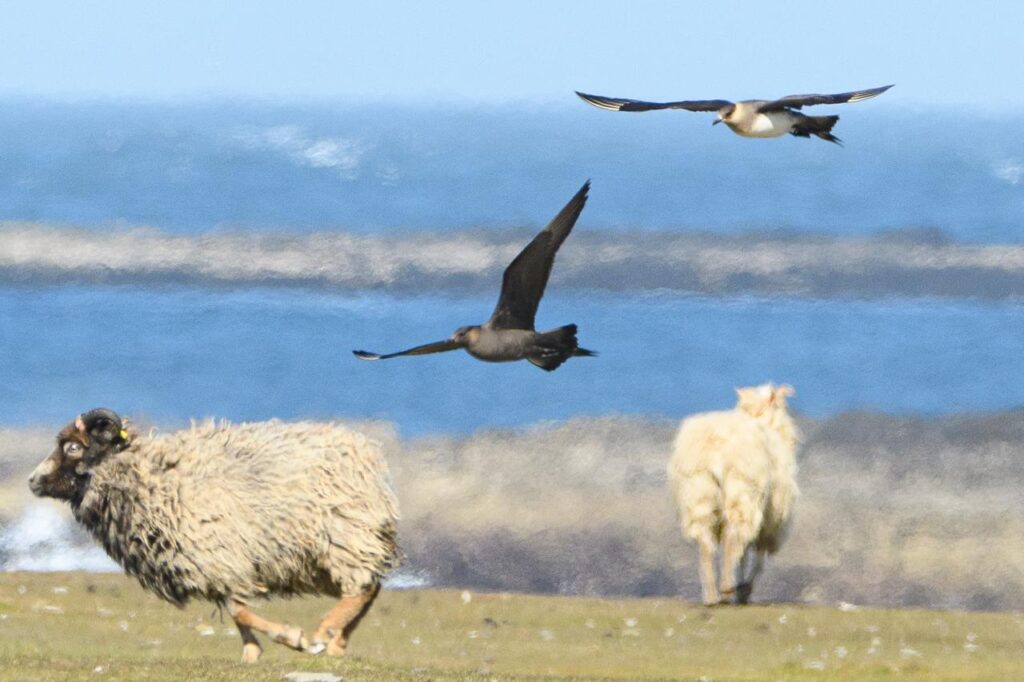
Arctic Skuas bombarding the North Ronaldsay sheep! (Sonja Herz)
The afternoon was expected to be rather quiet but the wind started to drop, the sun stayed out all afternoon and it was absolutely beautiful. We started down at the pier and had fantastic views of 7 Purple Sandpipers, their summery spotted breasts and rusty scapular feathers showing up nicely in the perfect light. A couple of Common Guillemot and Great Northern Diver were in the bay and we saw several Eiders including a female with a brood of ducklings. Next we drove to Ancum, parked the van and then embarked on a two-hour circular walk that would take us up the road and through the sheep dyke and Verracott and then out around the wild expanse of Torness.

Purple Sandpipers at the pier (Sonja Herz)

Turnstone on Torness (Sonja Herz)
It was a stunning walk with some brilliant views of both skuas – we saw a ringed Great Skua (originally ringed on Rousay and breeding here on North Ron for several years) and had close views of two pairs of Arctic Skuas including one attacking a sheep that had wandered too near its nest! The Arctic Tern colony entertained us and we saw the same dapper Grey Plover again. Ringed Plovers numbered 35 – the smaller, darker, tundrae race birds which eventually took flight together and went high north in a tight flock calling. The rest of the loop back via Nether Linnay was uneventful, but once back at Ancum we popped into the hide again to see if the Red-necked Phalarope would show better. This time we had the bird swimming in the open in beautiful late afternoon sunlight – a superb end to the day!

Red-necked Phalarope (Sonja Herz)
TUESDAY 27TH MAY – Sunny spells and heavy showers in a strong westerly wind, 11C
We departed Kirkwall this morning for the airport, in order to take the 1030 flight up to North Ronaldsay where we would be based at the Bird Observatory for the next three nights. The strong westerly winds continued as the low pressure system influencing us was only very slowly inching its way northwards and we received frequent heavy storms throughout the day off its southern flank. The flight was unaffected by the weather though and other than a slightly bumpy ride, we touched down on the North Ron airstrip on time. The community minibus was waiting for us so we were able to load our luggage and drive straight down to the Obs, where we met with Alison and were allocated our rooms. We had just over an hour before lunch, so opted to take a drive down to the brand new hide at Ancum Loch, to see what we could see.
This new, comfortable (and importantly, dry!) viewpoint is a fantastic addition and we had a great hour here watching small parties of waders dropping in, freshening up, and then continuing on. There were four Dunlin, probably local breeding birds, and then regular groups of Turnstone numbering upwards of 25 in total, mostly in dapper breeding plumage with some of the males being vivid orange on the back. Several small groups of Sanderling dropped in and then ahead of a rainstorm two Knot arrived – one being in full brick red summer plumage. An absolutely stunning bird and ‘new’ for some of the group in that plumage. There was also a constant coming and going of Arctic Terns, and six Bar-tailed Godwits which included one starting to show red mottling on the underparts. Three drake Shoveler, Shelduck, Curlew and Snipe completed the picture – with a couple of the latter seen distantly in drumming display flight. One of the real features of the island in late May is the number of young birds about – Lapwings and Oystercatchers having chicks all over the place.
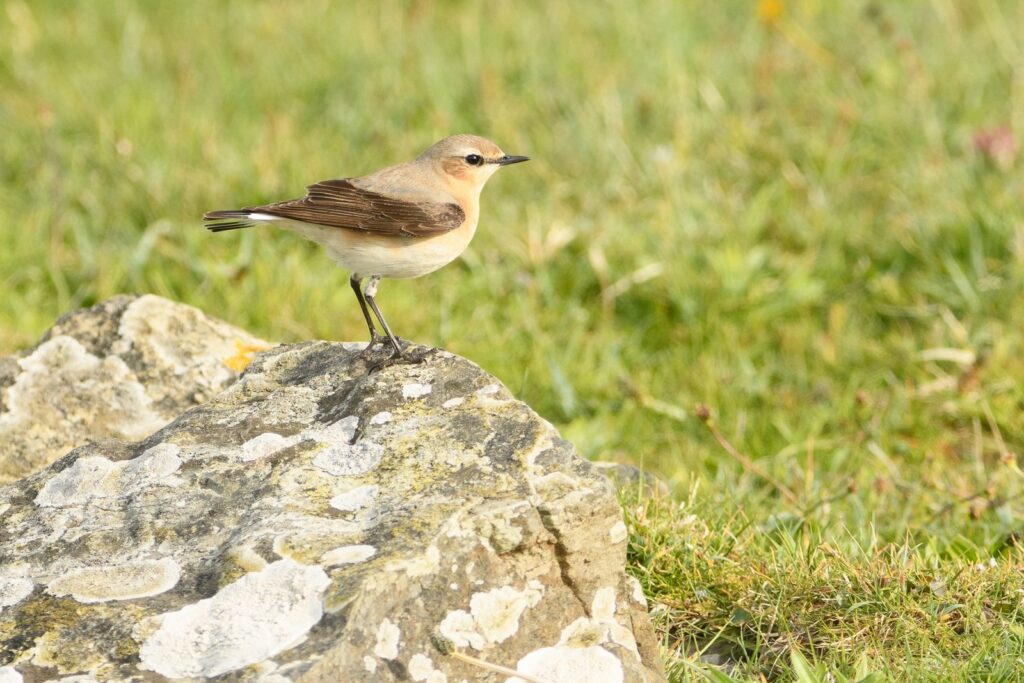
Northern Wheatear (Sonja Herz)
After an excellent lunch, we headed out again in the van and drove all the way up to the North end of the island. Bewan Loch held a fine drake Pintail and the grass between here and the lighthouse was covered in waders – Turnstone, Sanderling, Knot and Ringed Plover. We got ourselves bedded into the seawatching hide for a bit to avoid another deluge, and enjoyed watching a Ringed Plover with a tiny chick right outside the hide. The chick was often being brooded beneath the parent so that it appeared to have four legs! Offshore we had great views of four Great Northern Divers looking very dapper in the excellent light between the showers. A trickle of passing seabirds included Kittiwake, Razorbill, Puffin and Gannet, while Arctic Terns were frequently flying around calling and occasionally landing in front of the hide. Black Guillemots are another key feature of this time of year and as usual there were some superb views of them at close quarters here. A Whimbrel called a couple of times, but we didn’t see it.
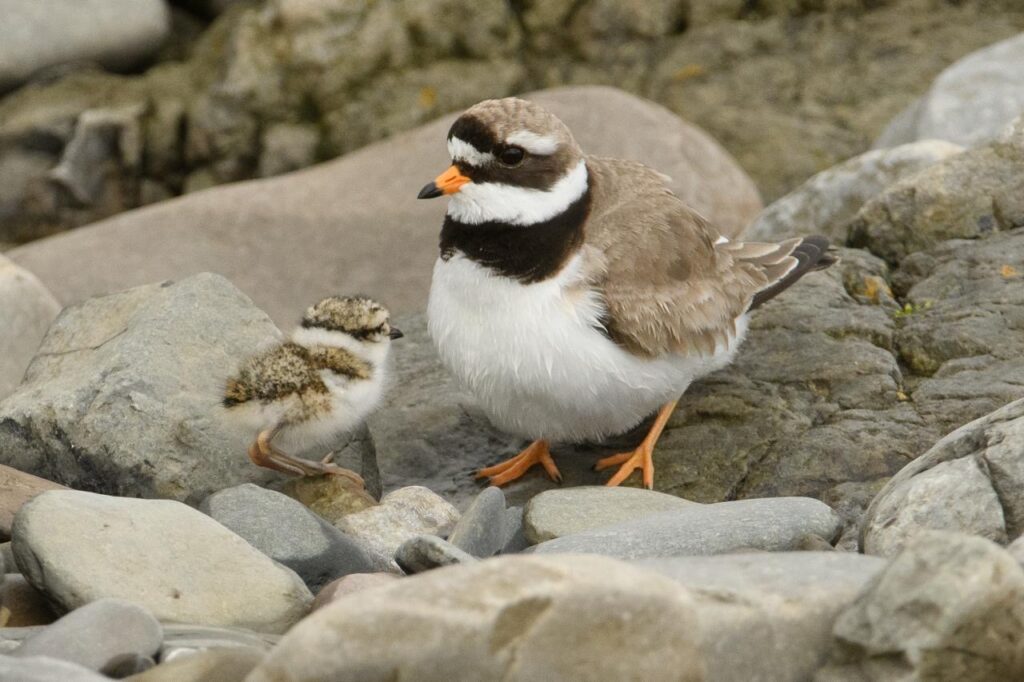
Ringed Plover and chick (Sonja Herz)
Heading up to the lighthouse to check Trolla Vatn we saw a nice pair of Wheatears on the grass, no doubt local breeders. A nice contrast shortly afterwards was a bright female bird of the Greenland race, very much a migrant and quite different looking to the other female. Ravens were playing around on the wind and a first-summer Kittiwake dropped onto Bewan Loch. From here we drove back to the Obs, and finished the day with a walk around to Gretchen Loch and another lovely new hide. This walk is always great for seeing Arctic Skuas and we were spoiled with mega views of three birds both settled and flying around – often sweeping past right in front of the hide. A Great Skua was seen too and there were again lots of chicks about of various species – including a lovely marble-faced young Redshank in the marestail outside the hide. Dunlin, Eider, Curlew and Arctic Tern were some of the other species present here. Not many migrants about to kick us off, but the magic of North Ron in spring meant the breeding birds more than made up for it!
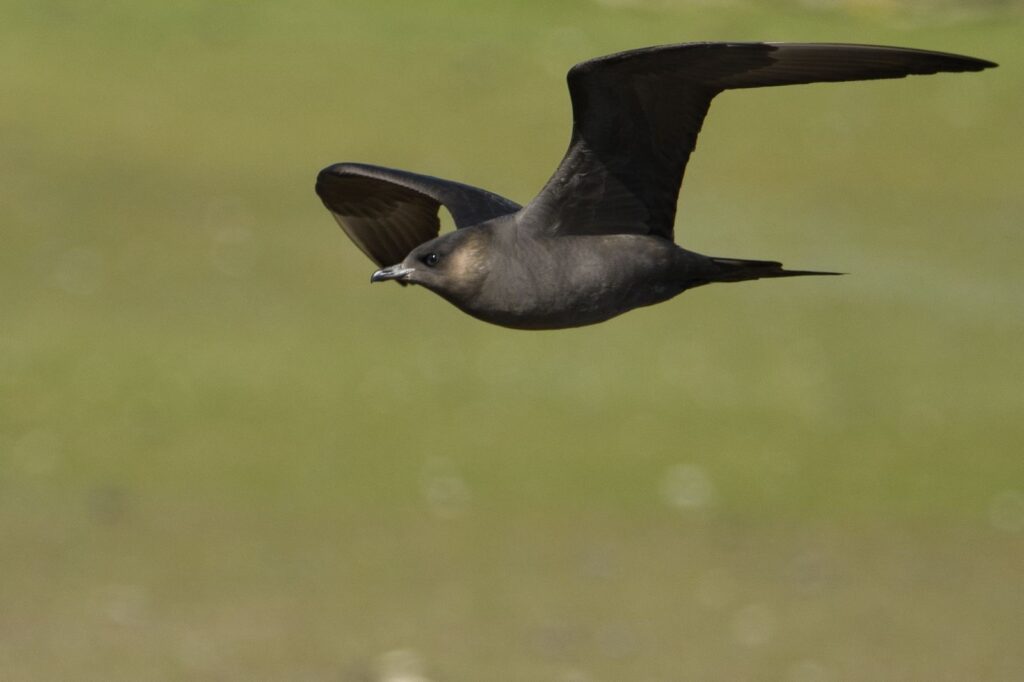
Arctic Skua (Sonja Herz)
MONDAY 26TH MAY – Sunny spells and heavy showers in strong Westerly winds, 11C
A superb days birding around Orkney Mainland today where despite the weather forecast, we managed to stay dry and enjoy some great birds! We headed out to West Mainland this morning, starting off by heading up the bumpy track towards the hide at Birsay Moors. On the way up, we had excellent views of two Whimbrel in a recently cut silage field, conveniently feeding with two Curlew for direct comparison. A bit further up, in another meadow, were five beautiful Golden Plovers in summer plumage. While we watched the plovers, we noticed several Brown Hares in the same field too. Up at the hide, things were fairly quiet though we had several views of Great Skuas cruising the moorland, and a dark phase Arctic Skua whizzed through too. There was no sign of the hoped-for Red-throated Divers though, so we headed down to Aikerness Beach to see if any were feeding in the bay there.

Red-throated Diver, Aikerness 26th May
We had to wait a few minutes in the van to dodge a very heavy downpour, but then it was back to blue sky and sunshine as we scanned the sound looking across to Rousay. We saw three Red-throated Divers, each giving stunning close views as they typically moved west to east through the bay feeding close inshore. Several nice Arctic Terns were about and at one point we had a Common Tern for comparison too. Common Guillemot, Shag, Red-breasted Merganser and Ringed Plover were among the other birds noted at this very pleasant stop.


Golden Plover (top) and Whimbrel (lower bird) with Curlew
Next we headed towards The Loons RSPB reserve, but had a couple of roadside stops on the way. The first was for a cracking pale phase Arctic Skua on the moorland, sitting close to the road. Then at Loch of Banks, we picked up Redshank, Wigeon, Gadwall, Shoveler and a surprise female Pintail for the list. The Loons hide provided an excellent shelter from the wind for lunch, and we enjoyed the antics of several birds with young on the pool in front of the hide, including a Little Grebe giving a piggy back to a tiny chick. The listening wall gave us a great view across the whole marsh, and we did see a couple of distant Black-tailed Godwits from this point, and got a good view of a bathing Snipe. A Great Skua caused a commotion when it flew in and raided a nest in the grass – everything for miles came to bombard it and it had to keep ducking out of the way of various Lapwings, Oystercatchers, gulls and Curlews!

Short-eared Owl in a rainstorm
Cottiscarth RSPB next, and while it was extremely quiet up at the harrier hide we did have a great view of a Redpoll on a fence line on the way up. As we descended back to the main road and turned towards Finstown, a deluge struck but we flushed a Short-eared Owl off a roadside post and saw it fly a short distance and land. This was a main road and tricky to stop but by turning and coming back a couple of times we were able to stop beside the owl crouched in the heather and get some superb views before a bus eventually flushed it! Top stuff!

Little Tern (Sonja Herz)
We rounded off the day by crossing Kirkwall and heading down onto Burray, where we wanted to look for the Little Terns in the afternoon sunshine. We saw five on the first beach we checked, along with a magnificent full summer Great Northern Diver in the bay, and several Ringed Plovers and three Sanderling on the beach. In nearby Echna Bay, we saw a fantastic 17 Little Terns all resting on the stoney beach and giving us great views through the scope. Both Common and Arctic Terns were here too, plus a couple of Eider, Fulmar and Black Guillemot. We’d packed a lot into the day, but it was now nearly 6pm and time to head back to the hotel.
SUNDAY 25TH MAY – Showery day with sunny spells and strong westerly winds, 13C
Today was largely a travelling day as those of us who had set off from Norfolk yesterday and stayed overnight at Lockerbie now continued our journey North as far as Inverness, where we met with the final three members of our six-strong group to make the final push North to Scrabster on the far north coast of Caithness. We had some time for birding en route though, and with lots of heavy rain passing through on the journey it was now largely blue sky and cloud but with a brisk wind whipping around the southern flank of an intense low pressure system to our North. We headed up the A9 towards Wick, stopping at the Loch Fleet area for a couple of birding stops.
White-tailed Eagle and Osprey (Sonja Herz)

White-tailed Eagle (Sonja Herz)
From The Mound, we picked up Curlew, Common Sandpiper, Teal and a few nice Red-breasted Mergansers. We were just watching a nice close group of Eiders under the road bridge when we spotted an adult White-tailed Eagle drifting in over the hillside to the north. The bird circled in beautiful light with it’s pure white tail gleaming in the sun, and then just to take the biscuit an Osprey appeared and started mobbing the eagle which rolled over to present talons! A second White-tailed Eagle, also an adult, then drifted in to join the party – all in all a pretty exciting first stop!

Ring-necked Duck at Loch Watten

Ring-necked Duck (left) and Tufted Duck drakes
We then drove around to the mouth of Loch Fleet and had a quick look there to see if there were any Eiders in the river mouth, but it was quiet so we backtracked to the pine forest for a short walk. Lots of wind here and not much doing other than a Coal Tit (lifer for our American group members!) and so we opted to continue north towards Scrabster. Once we were quite close to the ferry terminal we had about twenty minutes to spare so just picked a nice looking loch on the map to go and have a quick check in case there were any interesting ducks there. From the east end of Loch Watten, we could see a few distant Tufted Ducks on the choppy water but we were looking into the sun so it wasn’t easy. Having scanned through almost all of them, the last bird we looked at was a fine drake Ring-necked Duck! The choppy surface of the loch and wind made for some difficult viewing but eventually everyone had a good view of this Nearctic vagrant through the scope and we managed to grab a few record shots. From here, it was about 25 minutes to the ferry terminal.
Due to the winds, the ferry took a different route to normal, passing to the east side of Hoy and utilising the more sheltered waters there. As we rounded Dunnet Head, we began to see good numbers of a variety of seabirds – Fulmar, Gannet, Kittiwake, Guillemot and Razorbill all being common. Several Puffins were seen both sitting on the water and flying, and we noted the odd Manx Shearwater too. Altogether it was a very birdy crossing with something to look at almost continuously. The highlight were the two dark phase Arctic Skuas which appeared from nowhere and begun chasing an Arctic Tern really close to the ferry. Soon after, a Great Skua cruised by and towards the end of the journey, a second one appeared and hung off the stern for several minutes giving great views. A lovely close flock of chattering Arctic Terns, our first Black Guillemots and a summer-plumaged Great Northern Diver rounded things off as we came into Stromness. A long but exciting day!


