
TUESDAY 7TH JANUARY – Moderate westerly winds and sunshine. 3C
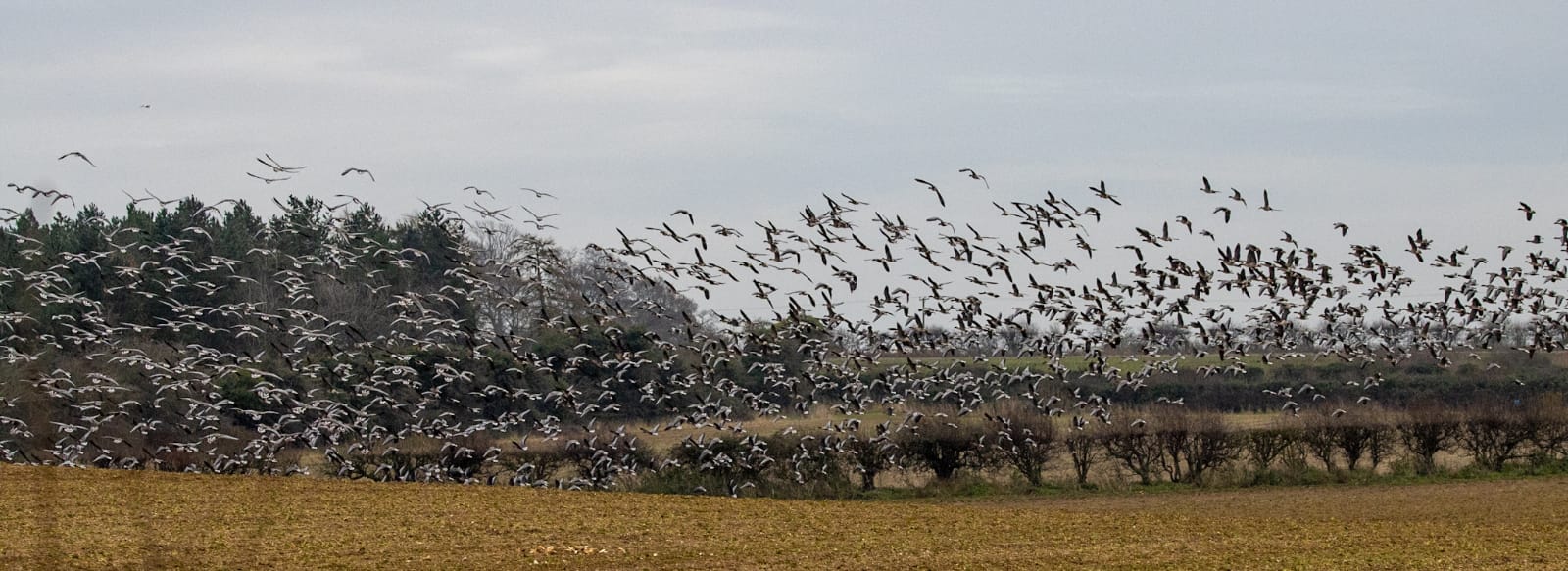
Another bitingly cold winter’s day but one which offered up some crackerjack birding! We started the day with skeins of Pink-footed Geese heading west against the morning sunrise as we loaded the van ready to head along the coast to Old Hunstanton. A young Glaucous Gull had been coming in there to a dead seal and commuting off to Gore Point, so we wanted to try for that first before the beach got too busy with dogs and people. As we crossed the dunes onto the beach, we could immediately see the Glaucous Gull standing proud on the tideline. A brute of a bird with classic latte-coloured plumage and an ink-tipped pink bill, it didn’t hang around long before flying back north towards Holme. The beach was also full of waders, especially Sanderling which were scurrying around right in front of us. Single Grey Plover and Ringed Plover, lots of Turnstones and a flock of Knot were also noted, as well as a couple of Fulmar flying south offshore. While scanning the beach, we then picked up the six wintering Shorelarks on the shingle ridge – a great spot as they were very well camouflaged against the sand and shingle! The light was good and despite the cold wind buffeting the scopes, we had some decent views of them before they disappeared back up the beach – a lucky start to the day!
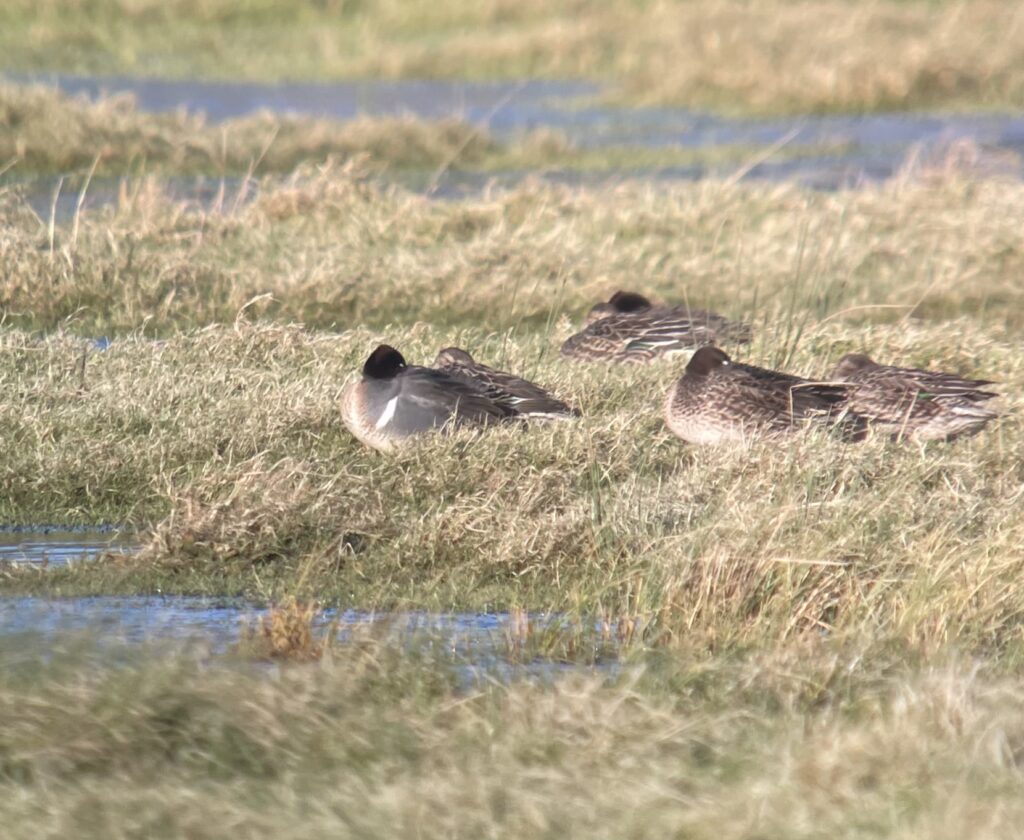
Green-winged Teal – our first view of the drake bird at Holkham, 7th January
Next we took a ride inland, looking for geese. We saw a good few skeins of Pink-feet but they were dropping into dead ground, so we left them to it and continued on to Holkham. The semi-resident Long-billed Dowitcher had been seen recently in the Lady Anne’s Drive area so we wanted to just check to see if it was about. There were lots of wildfowl along the drive – a few Barnacle Geese, lots of Wigeon, and near the north end, a flock of several hundred Teal. We parked up and had a casual quick scan through the Teal with bins – there sat amongst them as bold as you like was a cracking drake Green-winged Teal! Presumably the returning bird from last winter, this was still a nice surprise and we had super views of it in the perfect light. It was flushed into the pack by a passing Red Kite but hung around long enough for others to see it too, which was good. We never managed to find the dowitcher though!
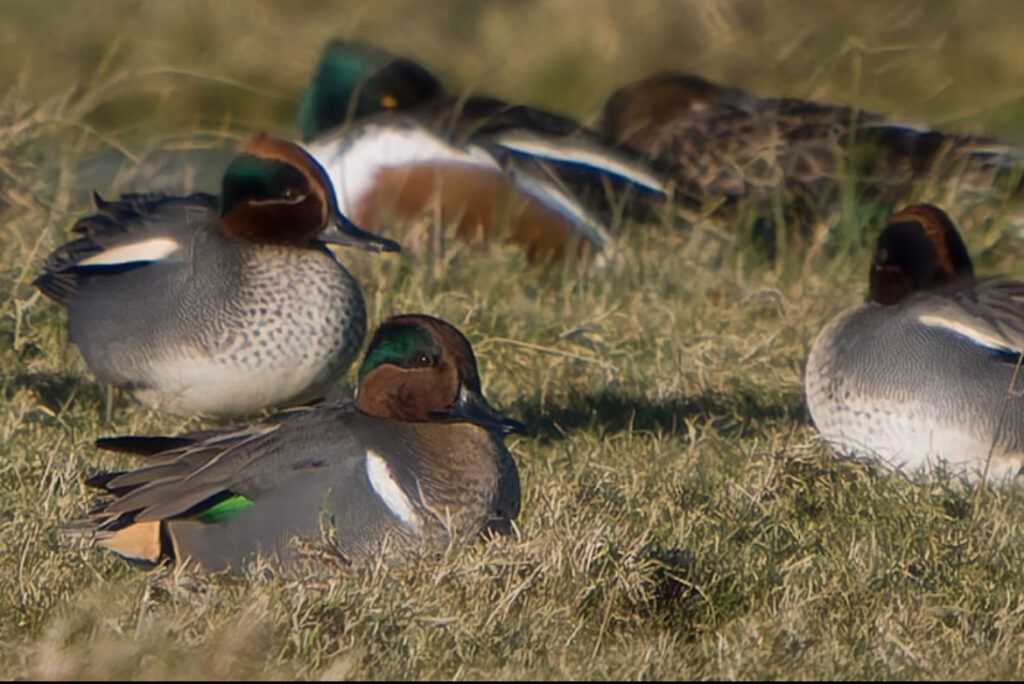
Green-winged Teal at Holkham. As well as the obvious vertical white chest bar, the lack of Eurasian Teal’s white scapular stripe, narrower yellow edging to the green head patch, and the warmer coloured chest can all be noted here. The lower photo was taken by Steve Gantlett (cleybirds.com)
Heading further east along the coast, we arrived to Sheringham planning to have a luck for Purple Sandpiper. The tide was right up and there was a huge swell running in, smashing big waves onto the sea defences. There was not only nowhere for the sandpipers to be, but we would get wet looking for them – so we gave up on that and instead enjoyed lunch in the sunshine overlooking the sea, watching one or two Gannets passing by. We then headed back along to Cley for a quick look at the beach road Brent Geese, before taking a drive inland to see if we could find any further Brent flocks. We succeeded in finding first a small flock of 300 and then a big flock of around 1200 further inland. They were spread out beautifully on a winter wheat field in good light, but we couldn’t spot anything rare amongst them. It was now time to head to Warham Greens, to try for the wintering Pallid Harrier.
The light off the end of Garden Drove was superb and we managed almost 90 minutes of watching before the bitter cold and impending dusk ended the day. The highlights were a superb grey male Hen Harrier which flew past us really close, having previously bee watched hunting more distantly towards East Hills. A Barn Owl followed suit, heading in the opposite direction, and we saw two Merlins – a distant hunting bird and a slightly less distant perched bird! The Pallid didn’t appear but there were several Marsh Harriers, a pair of Ravens, and another nice flock of Pink-footed Geese along the track. Not a bad day all told.
MONDAY 6TH JANUARY – Strong westerly winds and rain, dry later. 3C
A pretty grim weather forecast in store today as an intense front was passing east over Norfolk and out to sea, pulling in arctic air behind it. We knew it would rain until at least noon, and so had opted to head west to try and punch through the front and catch the first of the dry weather. This proved to be a great decision and we managed to pack in some really good target birds to an otherwise unpromising day. It took around an hour to reach our first stop at Knarr Fen near Thorney, where our target would be wild swans. Before we turned off the A47 we could see a large herd of swans out on the fen and thankfully there was a minor road that would take us closer. The good thing about horizontal rain is that at least you can shelter down one side of the van! That’s what we did and among the 800-strong flock of Whooper Swans we managed to pick out one adult Bewick’s Swan. There may well have been more but with the weather as it was, we accepted one and moved on! A bit further down towards the Nene washes bank, we found our next target bird in the shape of two adult Common Cranes. There were fairly close and so a little nervous, but allowed us to get out and scope them for a bit before they lifted as a beet lorry went past and flew off across the road. A good result – now time for a coffee and toilet stop!
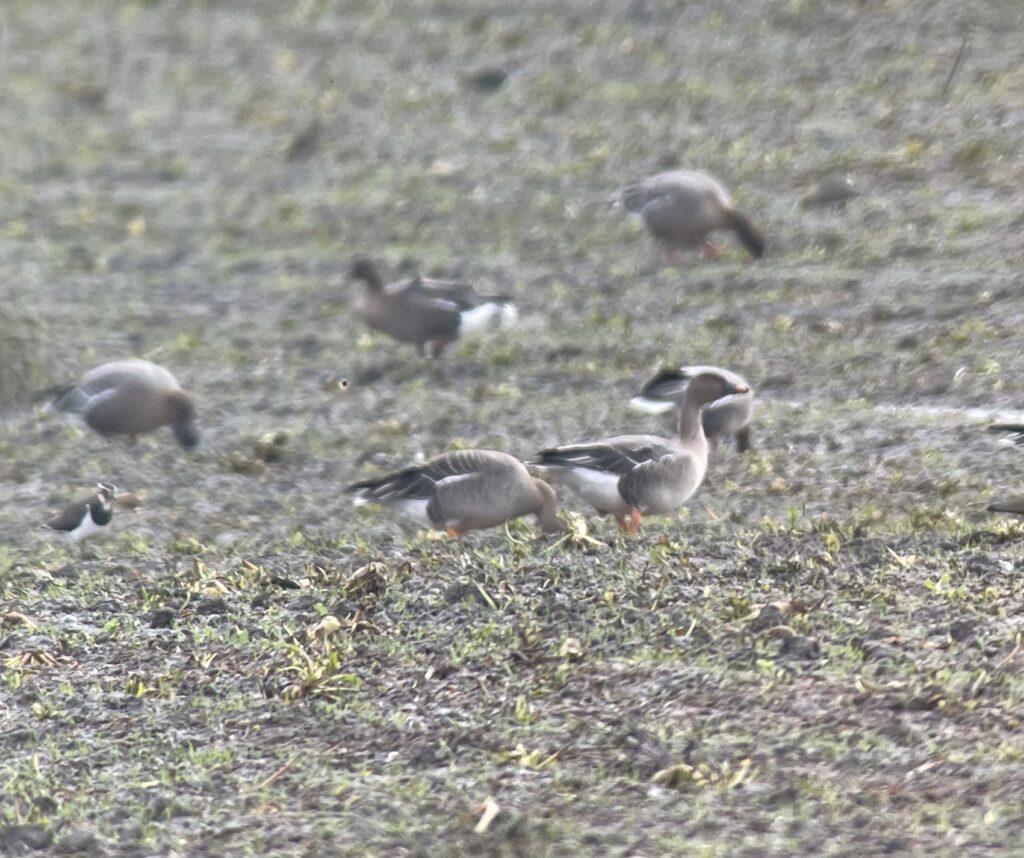
Tundra Bean Geese, Eldernell Farm, 6th January
We then got some ‘gen’ that a couple of Tundra Bean Geese had been seen around near Eldernell, so we headed straight there. Unfortunately though the Pink-footed Goose flock was not close to a pull-in, but there was a bit of a lay-by by the next field where another 600-odd Whooper Swans were feeding close to the road. From the van we scanned through and there were two grey geese among the swans – luckily, they were the Tundra Bean Geese! We used the van as a blind, as the birds were pretty close, and scoped from the rear of the vehicle without breaking the silhouette. We had superb views of the two rossicus, their bright orange legs really gleaming out in the gloom. There were lots of Golden Plover in the same field too, so we ended up spending a good while here. March Farmers was just up the road, and we got there at 1pm and lunched watching six Cattle Egrets feeding with the sheep.
As is often the case on mid-winter days, the time was racing on but next we wanted to visit the owl-hotspot of Eldernell. Surprisingly there was absolutely nobody else there so we would have to try and find the Long-eared Owls ourselves. We did manage to locate two birds, but because of the wind direction and strength they were really hidden among the dense hawthorns and we could only see bits of them. One bird did at least show its ear tufts though! We couldn’t find any Short-eared Owls but a bit further down we did have good views of the lovely rufous-phase Tawny Owl in its usual tree hole. Another Cattle Egret appeared and we saw a total of four Great White Egrets out on the washes, where there were also lots of Wigeon feeding. We ended the day scanning the wash and saw lots of Marsh Harriers coming to roost but not a lot else. The biting cold wind had finally got to us now and it was time to make the trip back to Titchwell!


