
FRIDAY 31ST JANUARY – Overcast with drizzle, 3C
Our final day of the trip started with a visit to adjacent Titchwell reserve. After seeing the Water Rail in its usual spot in a ditch behind the feeders, we headed more or less directly out to the shore to catch the back end of high water. The visibility was poor and the Common Scoter flock were typically distant in a fair swell, so seeing anything amongst them was going to be a challenge! We spent a good while scrutinising them and eventually everyone in the group managed to see both a Velvet Scoter and a Long-tailed Duck – it wasn’t easy, but we got there in the end! Four Red-breasted Mergansers were on the tidal pool and we had really close views of Grey Plovers in the corner of Volunteer Marsh beside the path. Popping into Parrinder, we had great views of all the ducks present including several lovely Pintail, and were able to notch up both Rock Pipit and Water Pipit, though the latter only made a very brief cameo. A male Hen Harrier ghosted past the hide really close but was soon gone off to the east, and a couple of Skylarks were watched on one of the closest islands.

Woodcock
Heading back down the west bank path, we took Fen Trail to specifically look for Woodcock which roost during the daytime in the damp woodland around the boardwalk, but which are notoriously hard to find. Our initial searches were fruitless, though we did see the Tawny Owl roosting in its usual tree. From the path between the VC and car park, we were more fortunate, spotting a Woodcock fast asleep under the bushes way back through a dense tangle. Critical positioning of the scope allowed us all to get a good view of this beautifully cryptic bird.
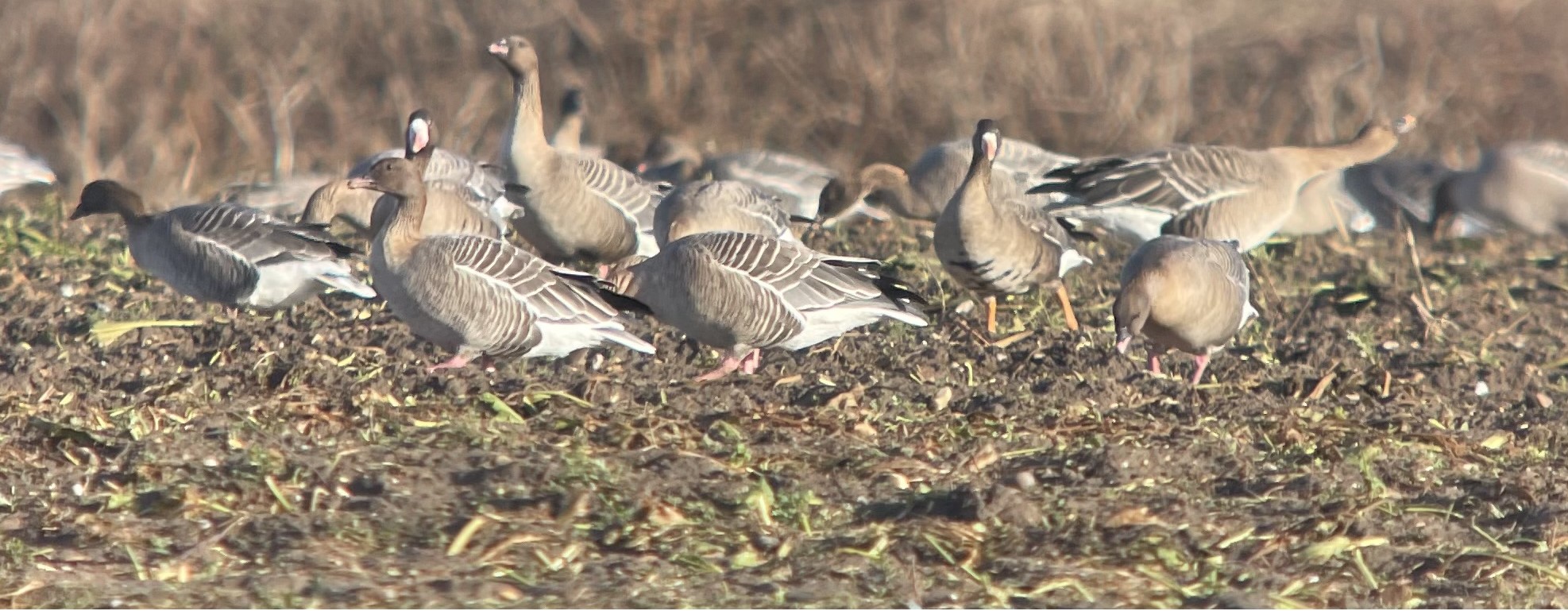
We now planned to head across to Holkham, but en route we wanted to check out a goose flock where a young Greenland Whitefront had been seen. The flock were nicely spread out and easily viewable from a gateway, and we saw at least ten adult Russian White-fronted Geese among them but the flavirostris was not visible unfortunately. Down to Holkham then for a late lunch, and a final roll of the dice to look through all the ducks for the Green-winged Teal that we found on the last tour, but which had been very elusive during its subsequent stay. Lots of birds to see, but no ‘GWT’, so we called it a day at this point and headed back to the hotel for drop-offs.
THURSDAY 30TH JANUARY – Calm and sunny in a cold westerly wind, 3C
We started off the day just a short drive from the hotel at Brancaster, where a walk down the beach to view the harbour entrance off the west end of Scolt Head was in order. The tide was starting to ebb but the sea was actually pretty rough despite a couple of days of calm weather, so we knew we would have to walk right to the east end of the beach to view the more sheltered area of water known as Cocklebight. There were lots of birds here, though mostly waders and ducks that we had seen already. A couple of stand-out highlights though were 14 Eider, including some super close views of one or two full adult drakes, and a posse of Red-breasted Merganser and Goldeneye diving together, close to the beach and in perfect light. We also saw a distant flock of over two hundred Pintail, but despite spending a good while scanning we could not find the regular Black-necked Grebe today.
Back at the van, we then set off on the journey south through the back lanes to Swaffham, and on into Breckland. On such a fine, clear day and with a little bit of breeze, we expected the conditions would be perfect for watching Goshawks. We weren’t to be disappointed, and in fact we had one circling above the road mobbed by Jackdaws on our cross-country route through North Norfolk on our way there! Within five minutes of arriving at our main viewing site, an adult female Goshawk appeared above the forest, powering around slowly on deep, deliberate wingbeats. We watched her for a while until she drifted off, and then two adult male birds came into view. At one point we had three Goshawks visible in the binoculars at once. The scope views were really good, and for most in the group these represented their best ever views. A Woodlark flew over but didn’t linger, and we saw a lot of Buzzards, a Sparrowhawk and a couple of Mistle Thrush too.
We lunched near Santon Downham hoping we might hear the first Woodlark song of spring, but we didn’t come across any, and so returned to Lynford. Up by the gate, two dapper male Hawfinch were showing really well, coming down to feed on seed. We watched them in the scope on and off for half an hour, often with a female Brambling on show too. This meant we really didn’t need to linger for the roost, and so after a look down at the bridge (adding Marsh Tit, Siskin, Goldcrest and Nuthatch) we wandered back up and set off back in the direction of the coast. A Little Owl territory en route sadly did not bear fruit so we finished the day at Thornham Harbour, to enjoy the last embers of light.

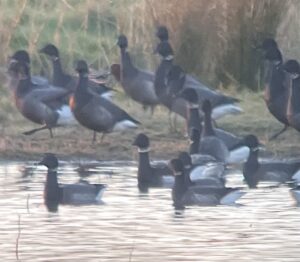
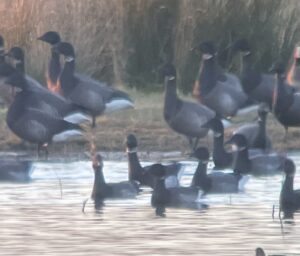

Black Brant at Thornham – note the huge white collar which joins along both top and bottom edge at front of neck, bold chalky-white flank patch as white as the undertail, and dark back.
As we arrived a flock of Brent Geese came in from the saltmarsh and dropped on the pools by the seawall, on the grazing marsh side. We crested the bank and scanned them, to find a smart adult Black Brant swimming at the back! A pleasant surprise but unfortunately a brief cameo, as the bird was only on show for about two minutes before the section of the flock it was with took flight and went out distantly onto the grazing marsh. In the tidal creek, we watched Grey Plover and Bar-tailed Godwit, and then a Greenshank which came into view on the rising tide. A nice end to the day!
WEDNESDAY 29TH JANUARY – Calm and overcast, 6C
A tremendous days birding today started with, you guessed it, three Cattle Egrets (and a Barn Owl) around the hotel first thing. Our plan was to head down to Snettisham to look for the Swedish reintroduction Lesser White-fronted Goose flock, and also the Dark-bellied Brent flock. We had a permit to drive down to the Rotary Hide, and despite the ebb tide we could see lots of birds way out in the distance on the mudflats – huge numbers of Shelduck, Knot and Dunlin in particular. Taking the crossbank around to the eastern side of the pits, we headed south and then up onto the embankment to check the fields for geese. We could see a large flock of Dark-bellied Brent Geese but they were hard to view in stubble and long grass, with a bunch of Greylags. Edging closer, we could see them better and there were a couple of Russian White-fronted Geese among the flock and we got a brief view of an adult Black Brant before the whole lot got flushed further back into the field by a Marsh Harrier. Viewing was tricky peering over the embankment and we couldn’t really crest the ridge for fear of flushing, so we left them to it hoping that maybe, while we were continuing our walk, they might eventually come over onto the pits.
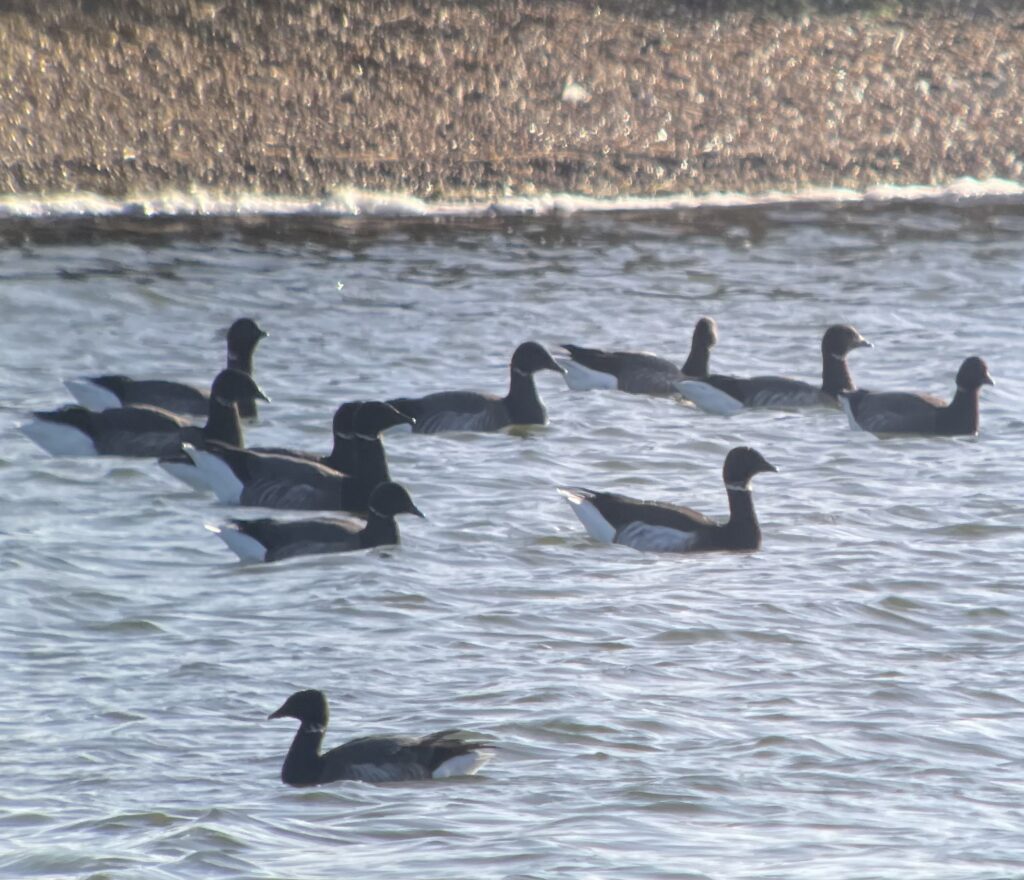
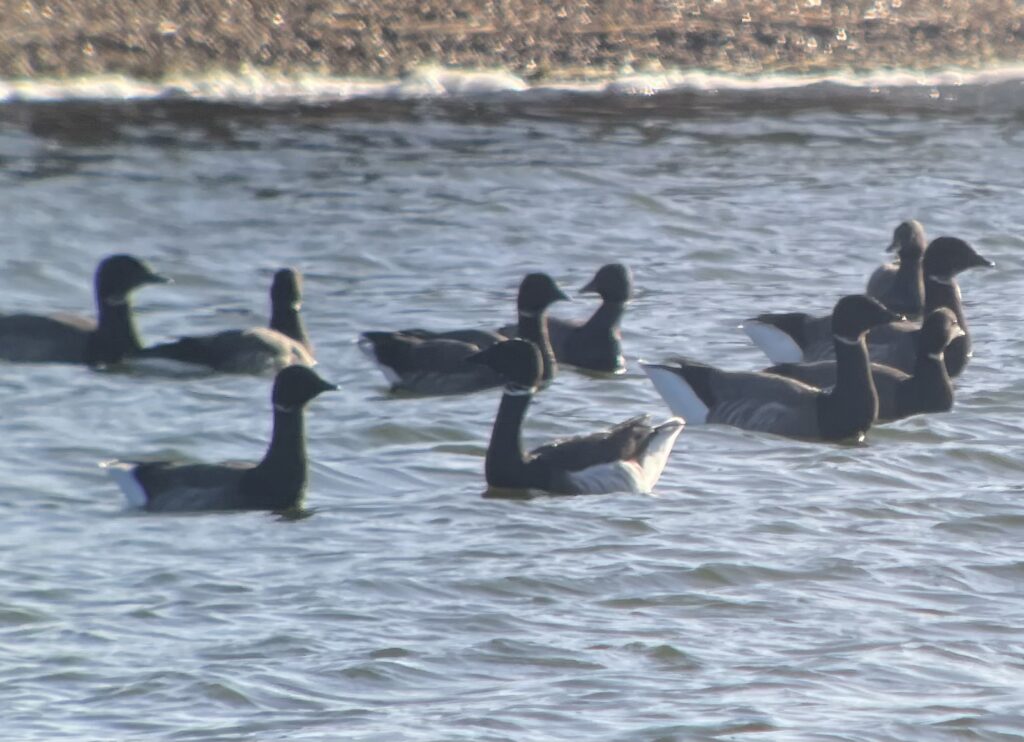
Adult Black Brant with Dark-bellied Brents at Snettisham
From South Screen we could see a few Goldeneye and a scattering more wildfowl and waders, but not a lot else, so we continued around towards Shore Hide. As we approached, the Brent flock came tumbling in from the fields and dropped onto the pits – game on! The light was not great from the hide and after checking the half of the flock to the left which were in decent light, we started on the second half which were positioned more or less straight into the sun. Despite this, we soon dropped onto a fine adult Black Brant and everyone was able to get good scope views – a classic bird with clean chalky white flank, black upperparts and large, complete neck collar. An adult Pale-bellied Brent was often in close company with it, so we had three forms of Brent Goose in the scope together at times! A great result and stroke of luck, as after about twenty minutes the whole flock headed back to the fields to feed. On the drive out, we were treated to more excellent views of a party of Goldeneye, with the drakes tossing back their heads and giving their low guttural call.

Lesser White-fronted Geese at Snettisham
While we had been birding down at the pits, news had come through that the Lesser White-fronted Geese had been relocated close to the Ken Hill seawall north of Shepherd’s Port. We were there within a few minutes and thankfully the birds were still there and showing extremely well – 24 Lesser White-fronts, in Norfolk! We were dead lucky though because a gyrocopter came through and flushed every goose within a mile radius, and everything flew off south towards the pits. A few minutes later though the ‘LWFG’ came back, and flew right overhead calling – just a fantastic sight and sound! This time they dropped more distantly, but we’d had great views, so we retreated to the van.
Holme was our next port of call, and our first picnic lunch of the week that we were able to enjoy out of the van! It was onto the beach next, at the Old Hunstanton end, to look for the Glaucous Gull and Shorelarks which had been around there for the last few weeks. As soon as we got onto the beach off the golf course, we could see someone watching the Shorelarks distantly to the North-east, and so we set off in pursuit. It was beautifully calm, and the sun was shining, and we head the light behind us too. We got superb views of the six Shorelarks, feeding voraciously on seeds among the strandline seaweed – just beautiful birds. As we headed back, the young Glaucous Gull appeared too – we never saw it fly in, but it was now sleeping on the beach not far out from where we had been stood. We had good albeit distant views before it took flight, circled around, and went north. Job done! Right, now for that Pallid Harrier!
Our previous visit to Warham Greens had left us wanting more, so we went back for seconds now the weather was perfectly calm and visibility was near-perfect. It turned out to be a total show-stopper of an evening, kicked off with a perched Merlin out to the east of Garden Drove. As dusk approached, Marsh Harriers began piling in and then a ringtail harrier appeared from the direction of East Hills, flying straight towards us. We could see a bit of a neck collar and really contrasting blackish and silver underwings, but the ochraceous underparts were heavily streaked and the wings were blunt and rounded – this was a juvenile Hen Harrier and not our quarry. The bird flew past close though, so we were now well equipped for when, or if, the real McCoy arrived. Next up was a fine male Hen Harrier, ghosting past to the west, and this was followed shortly after by a Short-eared Owl which spiralled up from the saltmarsh to see off a Marsh Harrier before gliding down on perfectly flat wings to its roosting spot once again. Three Barn Owls were seen, including two close passes right in front of us, but the light was fading and there was still no sign of the Pallid. Eventually, a shout went up to our left, but the directions were not to look west, or east – but to look up! The female Pallid Harrier was floating in right above us, and she slowly drifted out over the saltmarsh, flew up and down once, and then went to roost out among the sueada. Her long tail; rakish, long-winged silhouette and narrow pointed wingtip really created a kite-like vibe and quite different to the Hen’s we had already seen. We could see the paler, creamy underbody too, in the last of the light. A great way to end an amazing day – but just as two days ago, there was time for one last hurrah as the small matter of fifteen thousand Pink-footed Geese came in over us from the south-west, in long strings of straggly ‘V’s’, and out onto the distant sandbanks to roost. Norfolk at its absolute finest.
TUESDAY 28TH JANUARY – Light westerly winds and rain, 8C
A tough forecast was on the cards today as a low pressure system moved slowly eastwards across the county, bringing first heavy rain and then frequent heavy showers throughout the day. The best chance of some drier spells appeared to be out in the west, so we set off for the Peterborough area (notching up three Cattle Egrets next to the hotel on the way out). A little over an hour later we reached Knarr Fen near Thorney and had a slow drive around some of the fen roads to look for swans and cranes. We found a nice herd of Whooper Swans close to the north bank of the Nene Washes, and in the same area we saw countless Kestrels, Common Buzzards and a nice flock of Fieldfare. From here, and via a short pitstop at the edge of Peterborough for coffee and toilets, we continued on to Deeping Lakes reserve, just over the border into Lincolnshire.
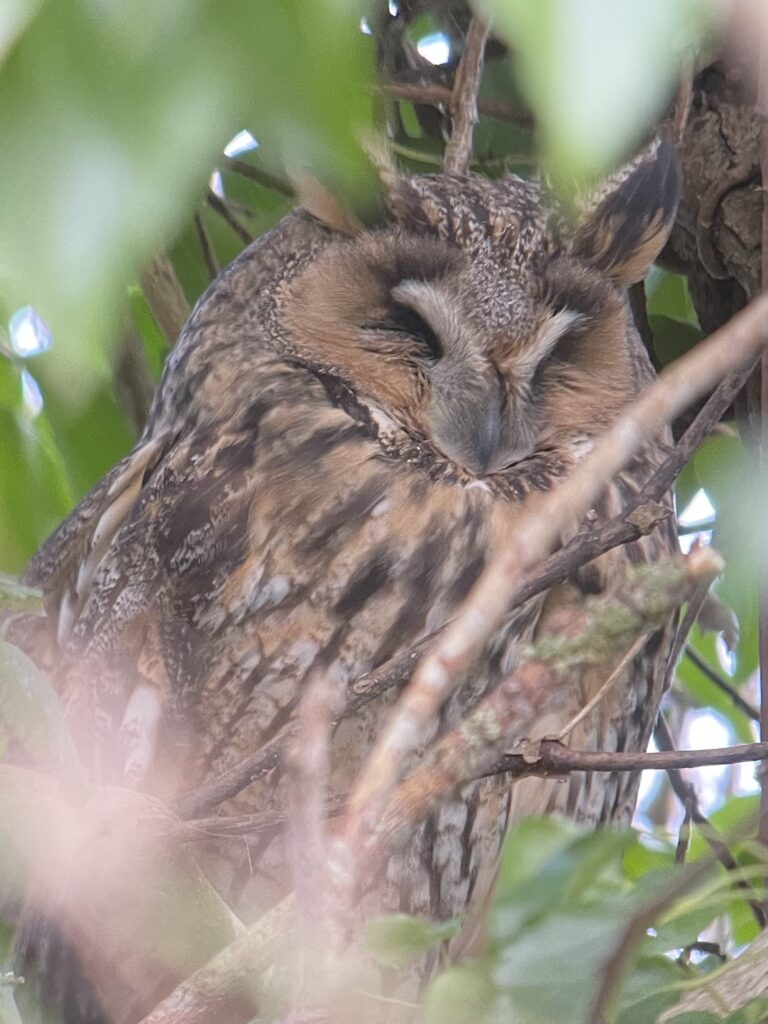
Long-eared Owl at Deeping Lakes
Our target here would be the winter roost of Long-eared Owls, and today we were in luck. Entering the hide, we slowly opened the flap and could see one of the owls sitting side on in the open only a few metres away in the ivy. A second bird, a little more buried, was sitting face on and gave us fantastic views through the scope. Out on the lake, lots of wildfowl included Pochard, Goldeneye, Gadwall and Pintail. A Kingfisher was also seen, perched in the reeds by the car park, so despite the rain, it had been a successful visit. As we made our way back towards Crowland, a lovely pair of Goosander were seen on the River Welland.

Short-eared Owl at Eldernell
Next we skirted back around the Nene Washes to the south side, to have another drive of some fen roads in search of cranes. The weather closed in but we found another swan herd and this time there was a single adult Bewick’s Swan with them. We were lucky to get good views before a gas gun went off – the swans were as surprised as we were and the whole lot took off trumpeting – quite a sight! Now it was time to head up to Eldernell to round off the day looking for more owls! There was a break in the weather long enough for us to find two Short-eared Owls roosting in the hedge west of the car park, and then a bit further down in the copse, the usual rufous phase Tawny Owl was in his favourite hole in a broken off tree. The marshes were also brimming with birds here – thousands of Lapwing, Wigeon and Teal, hundreds of Pintail and probably 500 Black-tailed Godwits. A single Great White Egret was also seen and best of all were four Cranes which gave good views looking north out towards the far flood bank. The rain started to close in again, so we called it a day and headed back to Titchwell with a pretty good haul!
MONDAY 27TH JANUARY – Strong Southerly winds and showers, 6C
It was largely a bright and breezy sort of day to kick off our second Norfolk Winter Wildfowl tour of the season. The day started with two Cattle Egrets feeding on the hotel lawn (we’d seen them here on the previous trip too!) and soon after just a mile or two away from the hotel, we were able to get stuck into our first Pink-footed Goose flocks of the week feeding on beet tops. We had excellent light and a good vantage point where we were able to disembark the van and scan properly with a scope, and this eventually yielded a lovely Tundra Bean Geese, barrelling along the top of the crest of the field and showing really well. Once you knew which part of the flock to watch, even at a quarter mile range you could see the orange legs glowing through the bins! We couldn’t dog anything else out of this five-thousand strong flock though so continued back to the coast road and along to Brancaster Staithe. A quick stop in the harbour added some beautiful close Teal, a couple of Ringed Plover and Turnstone.
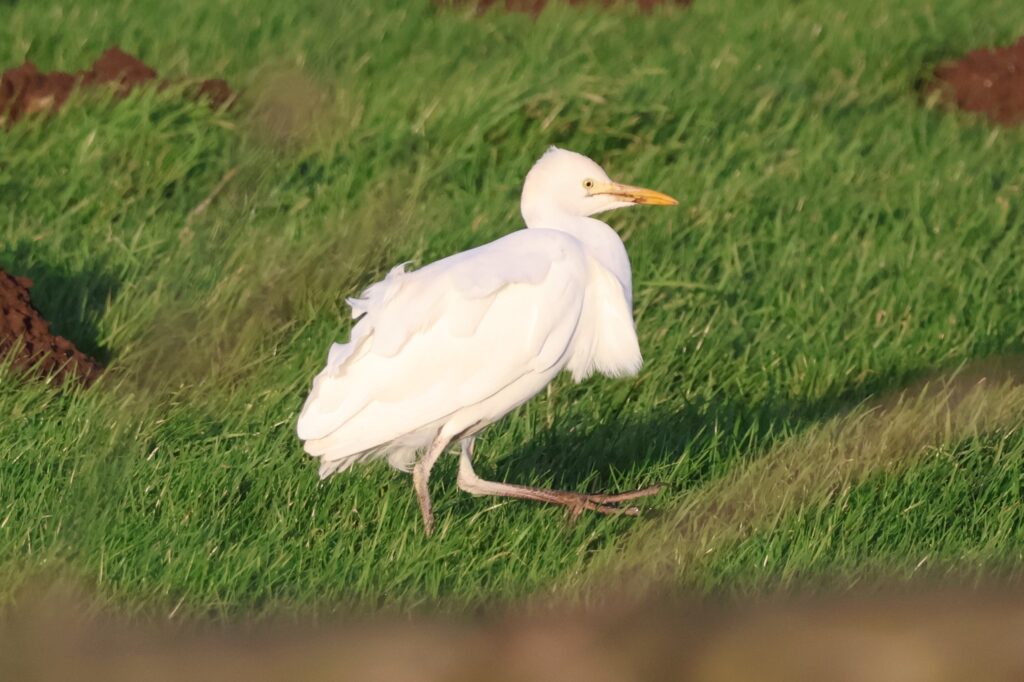
Cattle Egret – on the hotel lawn!
We had planned to stop in at Holkham Lady Anne’s Drive but it was closed due to the high winds (which really weren’t that bad!) and so we pushed on, via a quick look at some close Brent Geese at Wells, to the floods along the River Stiffkey valley. A Glossy Ibis which we originally found on a tour in November 2023 was here again for its second winter, and we had superb views of it in the sunshine opposite the Red Lion pub. Now gaining full plumage, its iridescent green and purple feathers really come to life on a sunny morning such as this. A bit further east, we decided to roll the dice and walk down to check the main flood, thinking about the Long-billed Dowitcher which was currently somewhere ‘in the system’ but not located! We saw stacks of Wigeon and Teal here, plus a Snipe and a few Black-tailed Godwits, but not the dowitcher.
Cley Visitor Centre next for a pit stop and looking north from the decking with the scope with the sun behind us allowed us to check the distant pools – a flock of Avocets and a couple of smart Pintail being the best of it. We drove down to the beach car park, and hoped the scoter flock which had been hanging around recently would still be close in. They were, and we had tremendous views of them diving in a tight raft just off the beach. Perhaps 400 Common Scoter in total – not the numbers seen at some other sites but one hell of a lot closer! We couldn’t pick any velvets out, but did add a few Red-throated Divers and Great Crested Grebes. The skies then blackened, and a torrential storm blew in from the south, and so this seemed a good moment to take cover in the van and eat our lunch!
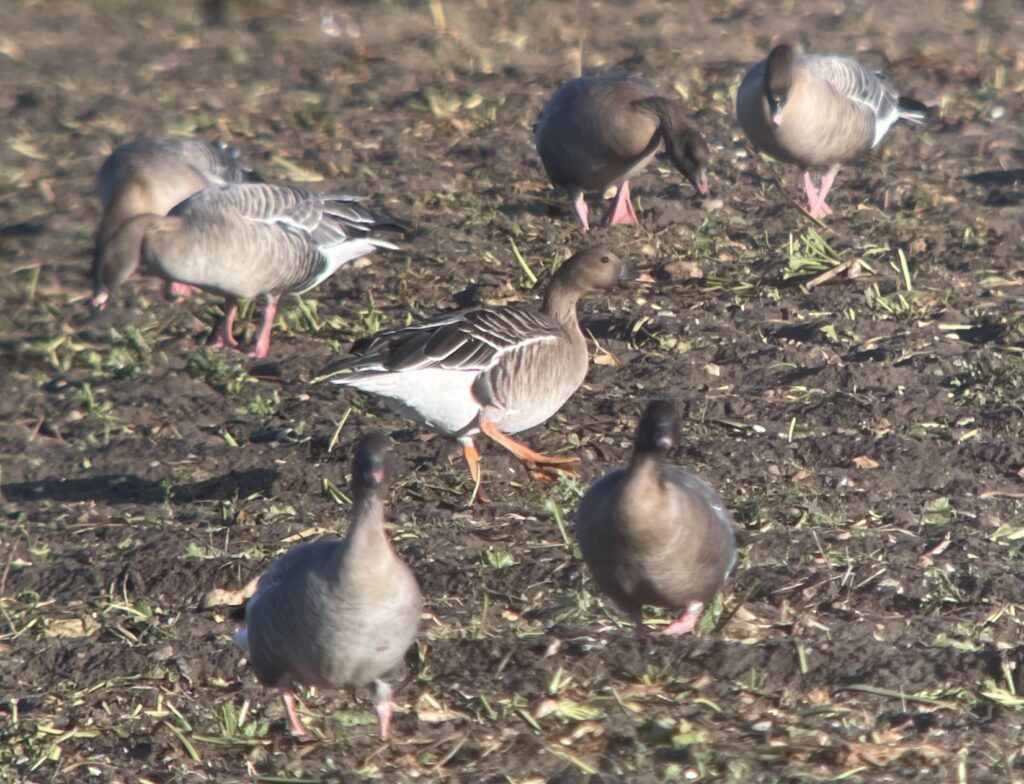
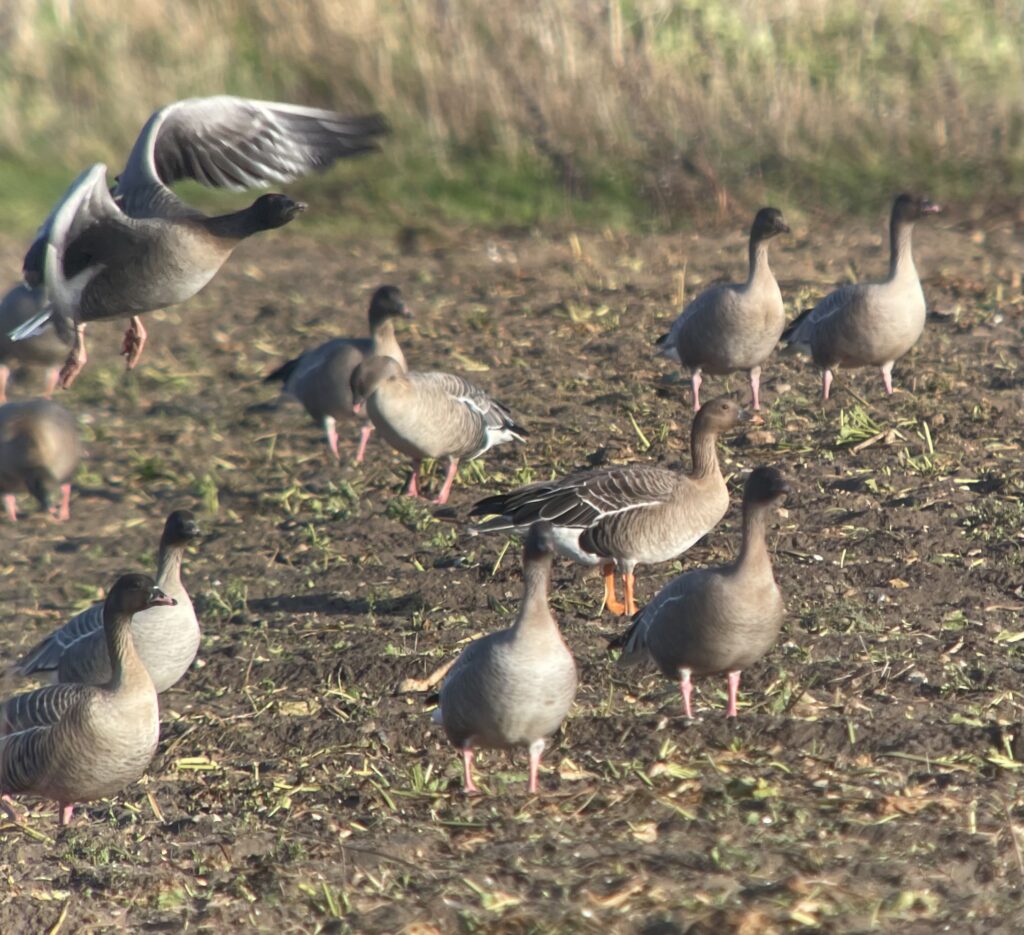
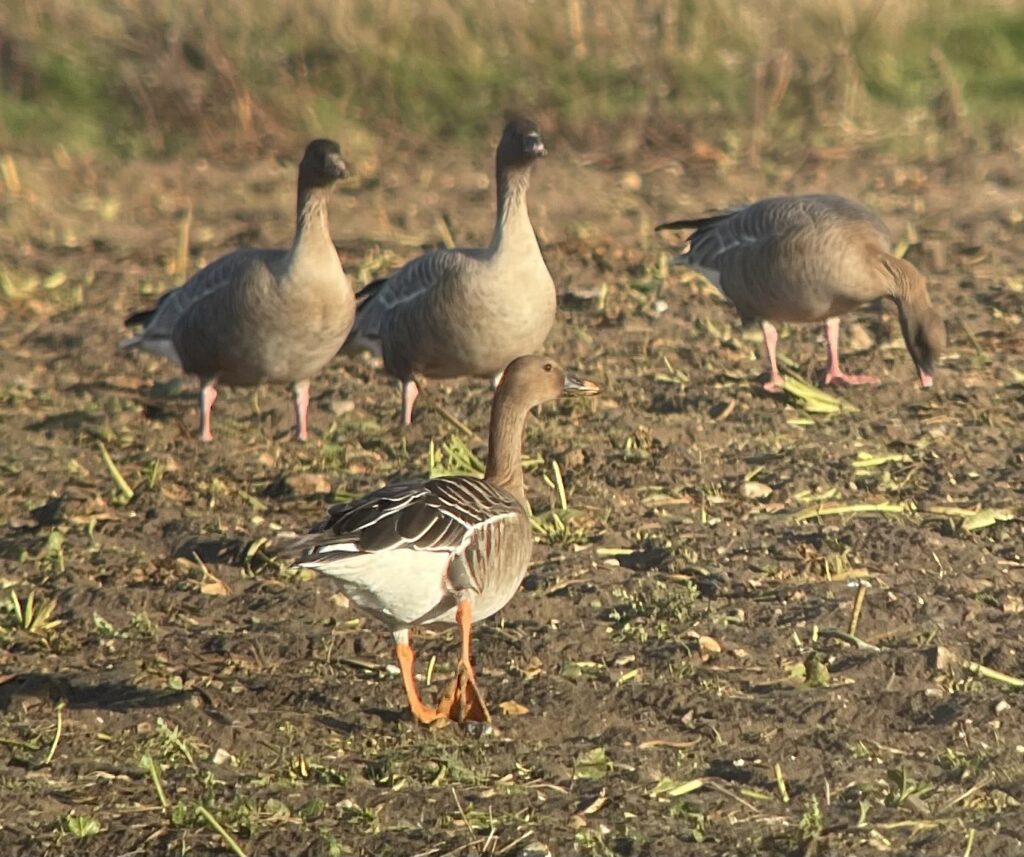
Tundra Bean Goose – one of the three adult birds seen at Weybourne
We had time still to head a little further along the coast to Weybourne, before our date with the Pallid Harrier at Warham. As we arrived there, things didn’t look promising as it was still raining heavily, but the radar suggested we had only five minutes to wait before sunshine! Sure enough the rainbow soon appeared and we were out of the van watching our second flock of Pink-footed Geese of the day. Now the group had their eye in, we could easily pick out the day-glo orange legs of a pair of Tundra Bean Geese among them from a mile off, and the colour palette was diversified further as the monochrome patterns of five beautiful Barnacle Geese then dropped in to our view as well. The light was now just magnificent, and so we walked down the track to get closer. This was prime goose watching, as we now had three Tundra Bean Geese really close in perfect light, plus a pair of Russian White-fronted Geese which waddled to the front edge of the flock. The same field had fifty-odd Golden Plover huddled down, several Skylark and a striking adult Mediterranean Gull too.
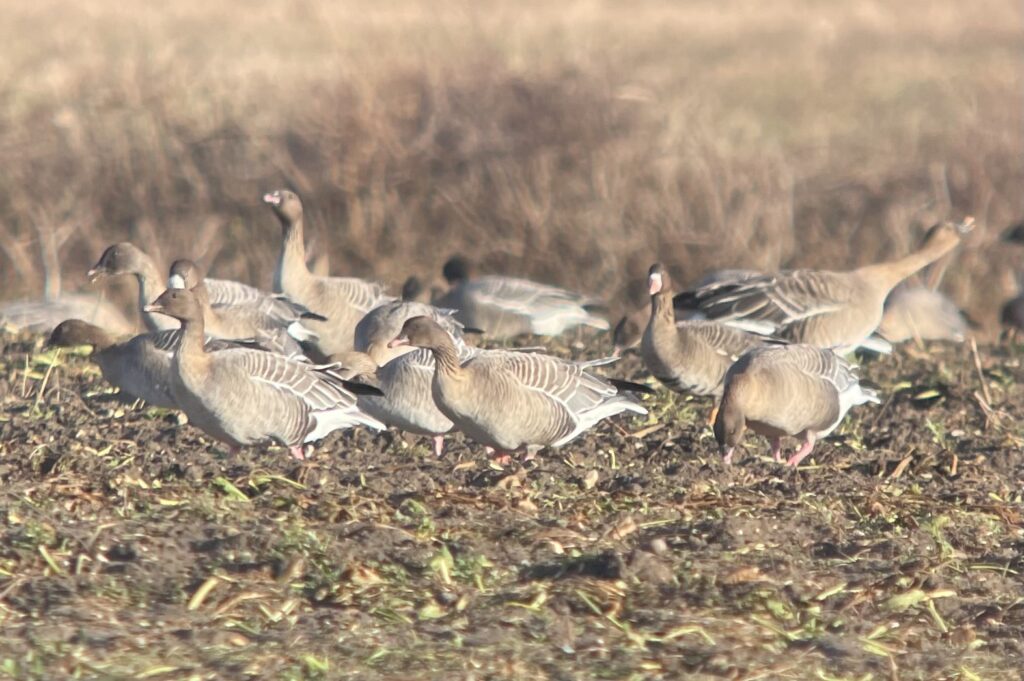
Pinkfeet, White-fronted and Bean Geese together at Weybourne
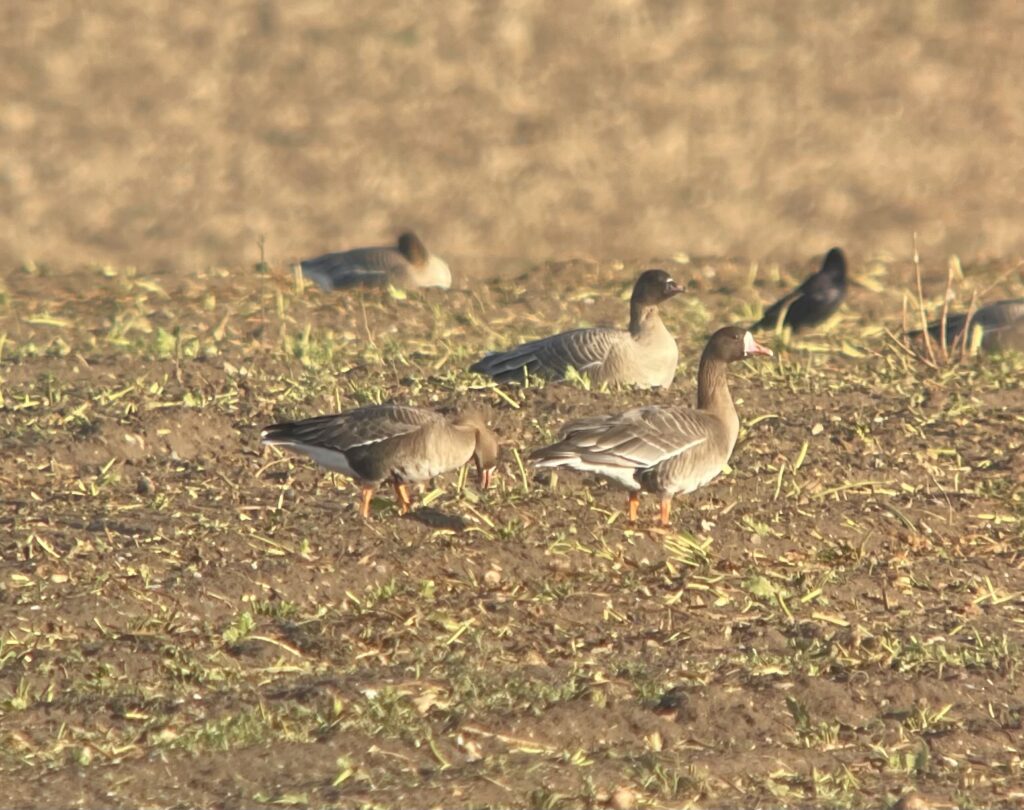
Russian White-fronted Geese at Weybourne
As is often the case on an action-packed winter’s day, the time had raced on and so we now needed to make our way back west, to Garden Drove at Warham. There was plenty of shelter from the wind behind the copse at the north end and we were soon watching the first Marsh Harriers coming in. A gorgeous grey male Hen Harrier gave a distant fly-past, but we watched in awe a little later as it flew past right in front of us – what a bird! A Merlin was less obliging, dashing through low over the sueada at range before perching half hidden in the grass. Our main quarry of course was the wintering 3cy female Pallid Harrier, and she did eventually appear way out to the east of us. After a couple of very brief, tantalising views, the bird did eventually quarter around long enough for everyone to see it, including briefly alongside a ringtail Hen Harrier for close comparison. Our way wasn’t even quite done then, as a magnificent roost flight of 15,000 Pink-footed Geese onto the sand banks was quite a sight, and a Barn Owl flew up the road ahead of us on the way home.


