
FRIDAY 17th MAY – warm and sunny in a light northerly wind, freshening to a moderate northerly later. 21C
We left Glasgow under sunny skies for the 150-minute journey to Oban. On reaching Loch Lomond we encountered some fine mixed woodland. It was not long before we heard singing Wood Warblers as we drove along. A total of at least 6 were heard, but as were on an A road it was difficult to stop. At the one lay-by we found there were no Wood Warblers to be seen or heard but we enjoyed the compensation of a singing Tree Pipit and a distant Cuckoo. Our scheduled stop at the Green Welly saw a fantastic collection of House Martins gathering mud for their nests from a puddle and several Siskins flitting around the conifers. The undoubted highlight was a mature White-tailed Eagle soaring high against a hillside but giving great views in crystal clear skies.
Arriving in Oban, where we met the final member of our group, we embarked the ferry for the journey up the Sound of Mull and then across the Hebridean Sea to South Uist. We saw a distant pair of White-tailed Eagles in a tree on the mainland and watched as one of them flew behind us to Mull. The weather was fabulous and the sea flat calm, which helped us pick out a splendid summer plumaged Great Northern Diver. Black Guillemots (tysties) gave excellent views.
Reaching the open sea, we encountered our first Manx Shearwaters and saw well over a 100 of them, in both rafts and flying low over the sea with their distinctive rapid wingbeats on stiff straight wings interspersed with glides. There was a good number of Puffins in the channel, always a crowd favourite. Otherwise, lots of Fulmars and Guillemot, with lower numbers of Razorbill and Kittiwakes. There was a trickle of Arctic Terns, but they were distant and we hope to improve views of those. A few were lucky to catch a fly by Great Skua, a species sadly decimated by bird flu in recent years. The final highlight was a pair of Red-throated Divers in the mouth of the entrance to Lochboisdale. A short drive later and we were at our hotel, the base for our exploration of these special islands.
SATURDAY 18th MAY – Becoming sunny, dry in a NW breeze. 14C
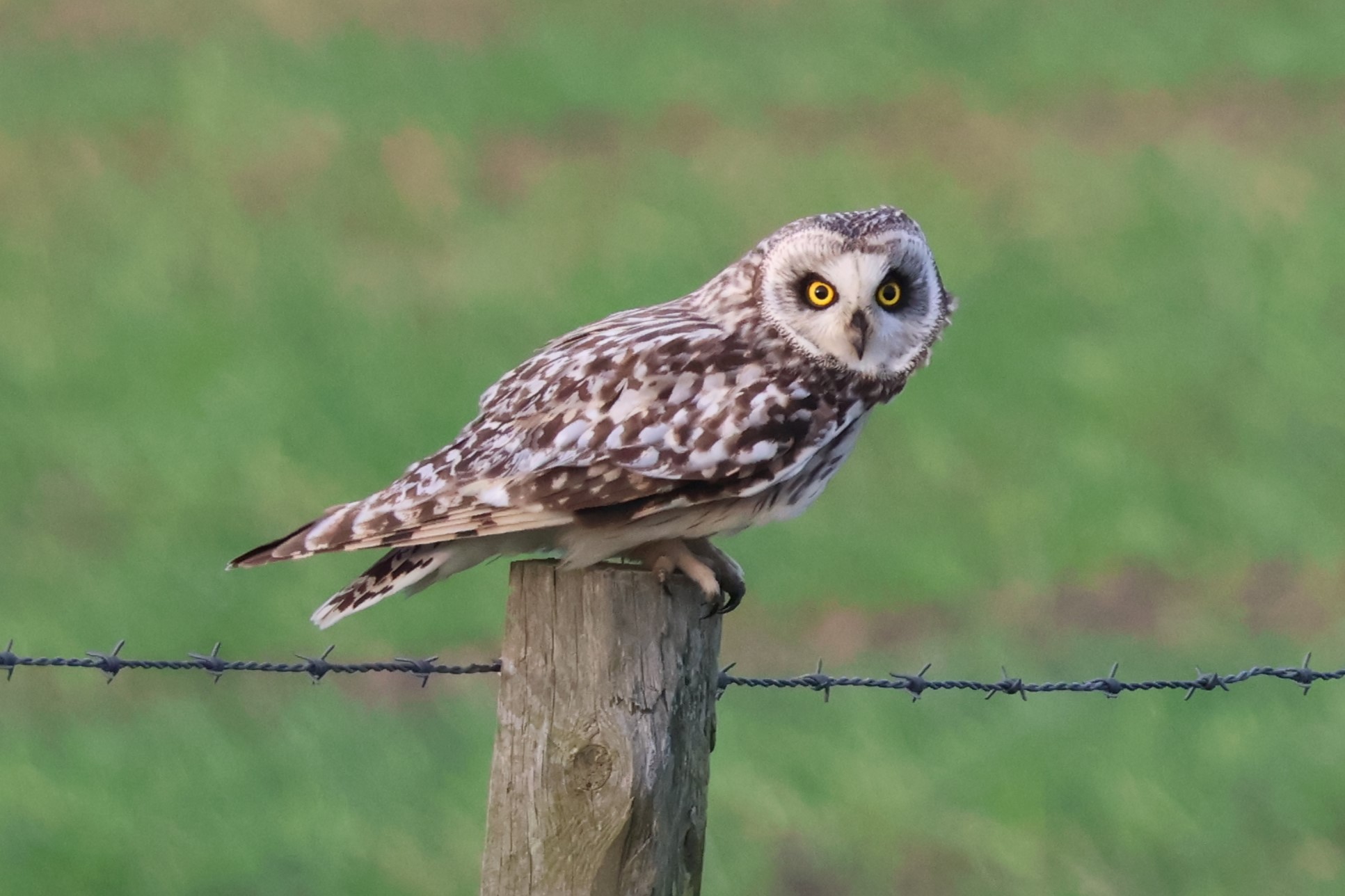
A cracking day of weather was matched by a cracking day of birding. Over breakfast Sue, who was rapidly becoming our Eagle spotter in chief saw an immature White-tailed Eagle fly past the window! Loading the car, we saw the first of seven Short-eared Owls today. This, another close fly by. A distant crekking Corncrake completed the picture.
Our first stop was at Loch Smercleit where a Pectoral Sandpiper had been found a couple of days before. It was low tide, and the beach was brimming with birds. A few Whimbrels were about as were three Bar-tailed Godwits. The small waders were very numerous, with many Sanderlings and Dunlin in particular. We walked the length of the beach and finally found the ‘Pec’ feeding in seaweed not thirty yards away. At that range the views were stunning, and each feather could be studied. A smart summer plumaged adult. It really was a very confiding bird which did not flush when the other waders were spooked by a passing runner.
As we returned to the van, we heard a commotion and saw a dark phase Arctic Skua being escorted off the premises by a Lapwing. Good stuff.
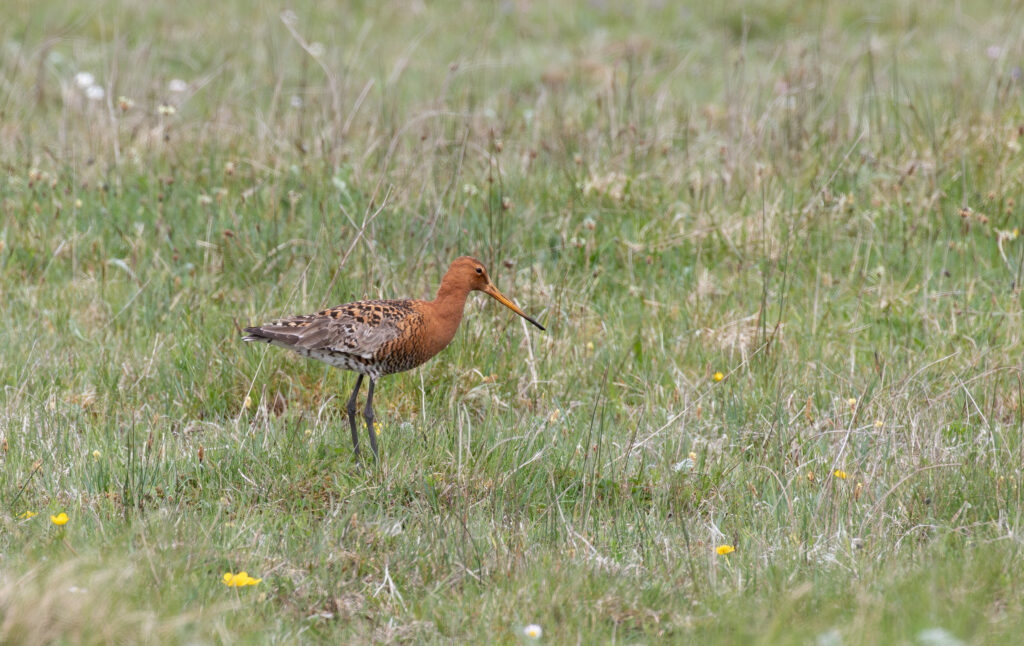
Our next stop was Rubha Ardvule the westernmost promontory on South Uist. Always a good spot, it did not disappoint. There were probably 400 Sanderling on the beach plus plenty of Dunlin, Turnstones and Ringed Plovers. Probably the best birds here were a couple of Black-tailed Godwits. They were islandica birds, in full summer dress, feeding up before making the final hop to Iceland to breed. On the way out we added close views of Cuckoo and our first Rock Doves of the trip.
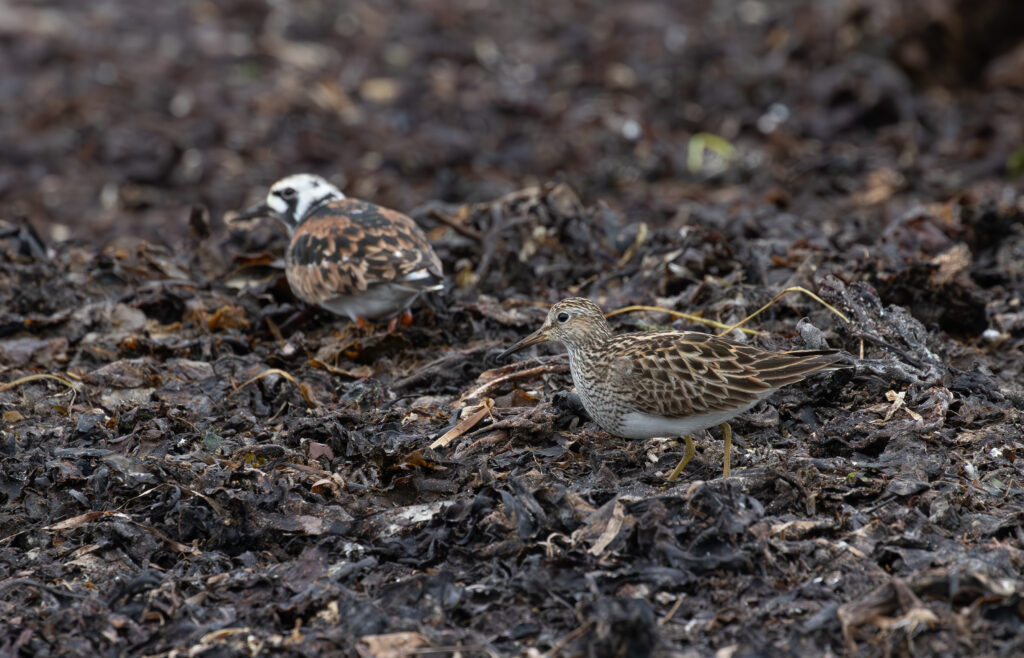
Pectoral Sandpiper with Turnstone – Smercleit, 18 May
The morning had been overcast but the sun was now burning through the clouds. It was time for lunch and raptors. We headed up to Loch Druidibeg and parked up. No sooner had we left the bus when first one, then another White-tailed Eagle appeared from behind the far hills. They gave good views as they spiralled up and away. After lunch we took a walk around a plantation adding Willow Warbler, Goldcrest and a flyover Redpoll sp to our tally. Best of all we scanned a far mountain and spotted a large raptor low against the slope. Putting a scope on it we were able to pick out the golden nape on the bird and when it flew above the skyline the distinctive silhouette of a Golden Eagle. As the eagle circled it was mobbed by both a Raven and a Hen Harrier. As usual it paid little attention to either, as it drifted slowly out of view. So, a fairly distant sighting but great to get it in the bag on day one on the islands.
Time to move on. The wind was in the west and although light we thought that we should check in at Aird an Runair in case any passage skuas were about. The walk down to the point was entertaining with yet more waders including a brief Purple Sandpiper and lovely views of the Arctic Terns nesting on the machair. A short sea watch followed. In truth it was quiet, but we managed a couple of Manx Shearwaters, a scattering of Kittiwakes and a few Great Northern Divers. The walk back was excellent. With the setting sun behind us we saw two separate pairs of Arctic Skuas come storming through terrorising the waders on the beach. The views they gave were just fantastic and we had the opportunity to study them closely, as they were on show for a prolonged period.
On the way out of Balranald we stopped to listen to a crekking Corncrake. It was too distant to see, but just then Marilyn found a female-type Black Redstart behind the toilet block. It was fairly skittish, but we all enjoyed good views of it. A scarce bird in these parts so another good one to bag. By now it really was time to go home. However, on the drive out we heard at least four different Corncrakes. We had to stop. It took time but eventually one showed in a developing iris bed. A classic view with the head and neck showing as it crekked heartily. Fantastic and a lifer for some. To add atmosphere a Common Snipe was displaying above us and the sound of the “galloping horseman” really added an extra something.
The journey back to our hotel was uneventful, but we did see two more Short-eared Owls and two male Hen Harriers, one of which skimmed the bus as it flew across the road. A great end to an excellent day.
SUNDAY 19th MAY – Dry, largely overcast in a gentle NW breeze. 13C
Our target this morning was an adult American Golden Plover that had been found yesterday on the Range, just west of Loch Bi. On reaching Loch Bi we worked the southern shore. The twin highlights here were a pair of Greater Scaup asleep in the centre of the loch and a distant Otter. Moving on to the Range proper, a vast area, we began to search for Golden Plovers. We found a few but not the AGP. We kept going and suddenly the bird popped out of a rill into full view at a reasonable distance. Moving closer we were able to observe all the key identification features; slim build, all black underparts, a restricted throat and upper breast white patch (not extending to the flanks) and a black and gold coloured mantle. All in all, subtly different to the accompanying Eurasian Golden Plovers. The birds were happily settled and so we put the news out and moved on.
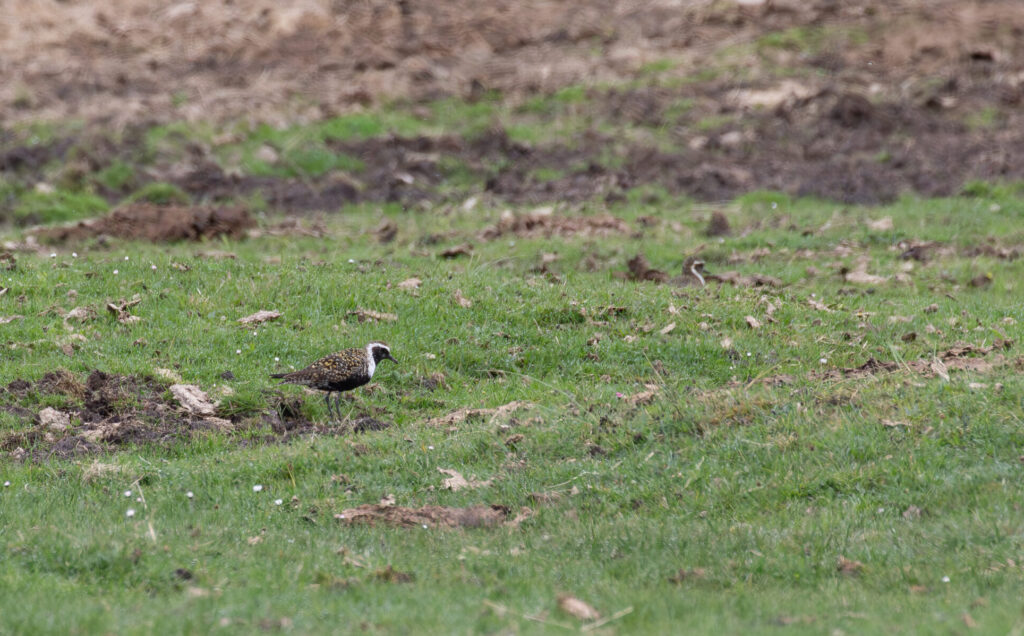
American Golden Plover – The Range, 19 May
Exploring the rest of the Range revealed more Golden Plovers, Ringed Plovers and Redshanks. The highlight was a pair of islandica Black-tailed Godwits. The male was in absolutely stonking plumage with a particularly rich and lustrous burnt orange coloured head, throat and breast.
Leaving the Range we reached Ardivachar Point and took lunch. As usual here wader numbers were high. Although many were too far away to view, among the Sanderling, Turnstones and Dunlin we found two Curlew Sandpipers, one coming into full plumage. These birds are not easy to find on the islands, so these were a welcome bonus. A flock of 100 Bar-tailed Godwits was impressive for these parts. Finally, we spied another White-tailed Eagle sitting on a skerry in the bay. The ducks in the bay, mainly Eider took no notice of him until he flew. Then the ducks took fright and flight, not settling until the Erne had lumbered out of view. On the drive away we added three Little Terns and a distant Corncrake.
We next headed to Benbecula and tried a moorland drive. This was successful as we found a pair of dark phase Arctic Skuas. It looked like the female was on a nest and the male standing watch on a grassy hummock. After a short time, the birds flew up and began alarm calling. Not something many of us had encountered before, quite a soft mewing call. The cause of the panic was yet another White-tailed Eagle flying high over the moor. The female soon dropped back on her nest, but the male flew to a small hillock, much closer to us, and stood sentinel over his mate. The final action here was a splendid grey Hen harrier quartering the moor near us.
Next we worked a lochan with a few ducks including a nice brood of Shoveler chicks. It seemed relatively quiet but just as were climbing back into our vehicles two Red-necked Phalaropes were spotted flying onto the loch and began swimming in emergent vegetation. The views were relatively brief, but good and we could see that it was a pair. We moved on and drove to another promising location. After a short wait we were rewarded with another female Red-necked Phalarope. She was very close and afforded excellent prolonged views when she stood to preen on the water’s edge. Such diminutive birds it is hard to credit the colossal migration they undertake to the south of South America every year.
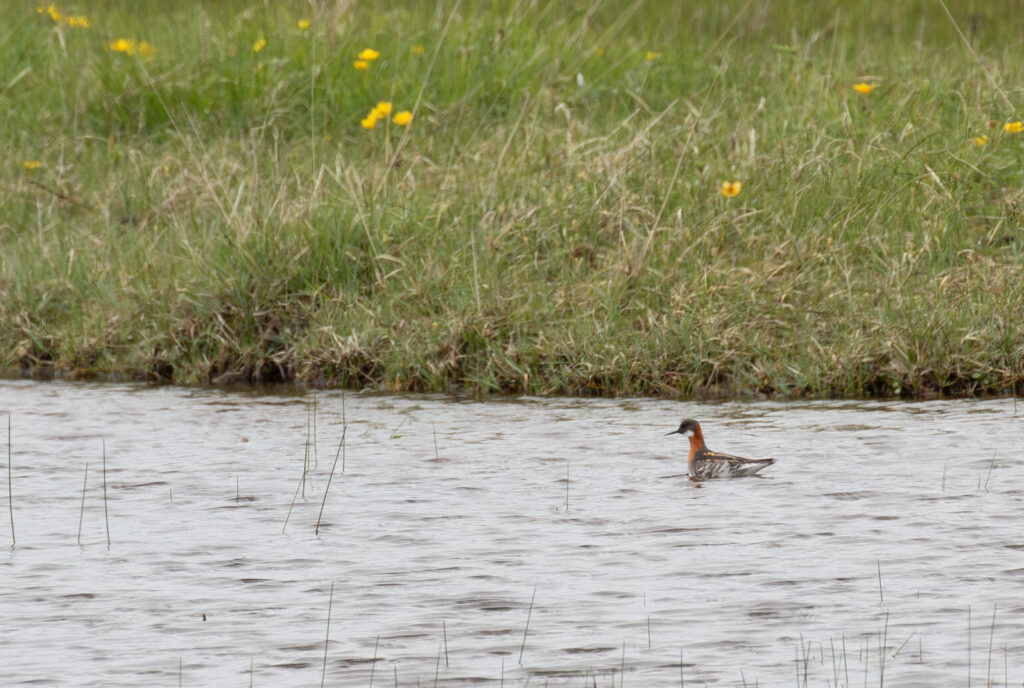
Red-necked Phalarope – 19 May
Having filled our boots here we intended to finish the day at Stinky Bay. Yet more waders were about, but we could find nothing unusual with them. We observed a flock of waders dropping into another bay further south. So, we rolled the dice and drove a rough track to this bay. The waders were plentiful, but the show was stolen by an Otter, expertly picked out by Olwen. It had just caught a fish and was sitting on a rock eating it. We were able to approach fairly close and watched as he finished his meal and then slipped back into the sea. There was a second Otter about, but we had only a short view of this animal. We walked back to our vehicles very content with this finale to another wonderful day.
MONDAY 20th MAY – Sunny and warm in a gentle SE breeze. 20C
It is a rare day in May in the Outer Hebrides when the thermometer reaches 20c. Today, we enjoyed that rare day. The sun was already cracking the flags when we pulled back the curtains this morning. A pre breakfast amble produced a reeling and showing Grasshopper Warbler for some. After breakfast there was a filthy twitch by the rest of the group to see it. Whilst watching him, we enjoyed views of two White-tailed Eagles, two Short-eared Owls and a male Hen Harrier. Not a bad haul to start the day.
Our chosen area to bird today was North Uist. We started at Loch Sandary. Usually, a productive spot it was not so good today. “Atlas” a local sheepdog disgraced himself by running around half the loch, flushing everything in sight. Despite a stern reprimand from his owner and a brush with an irate Whooper Swan that saw him come off second best, the damage was done. A Common Sandpiper was the best we managed. However, driving away we were pleased to spot a Corncrake fly across a field and land beside a nettlebed and begin crekking. Whilst watching him we spotted a second bird, also out in the open. Over a period of twenty minutes, we enjoyed some good views of this charismatic skulker.
Moving to the coast we found a quiet spot that held decent numbers of waders and duck. Nothing rare but a lovely location particularly on such a sunny day.
After that we drove the northern coast road. Stopping in one likely spot we saw 3 White-tailed Eagles circling high in the sky, before they disappeared into cloud. A little further along we saw a Golden Eagle, that showed all too briefly before disappearing behind a ridge.
It was a day for raptors, so the Committee Road was next. Before we had driven half a mile we struck gold. Two adult Golden Eagles came up over a ridge and the male began to display. A rollocking roller coaster performance that at times was difficult to follow in the scope. Fantastic stuff! We took lunch at the highest point on the Committee Road, where we added another two White-tails, one giving point blank views. A pale phase Arctic Skua gave a prolonged fly past as did a hunting female Hen Harrier.
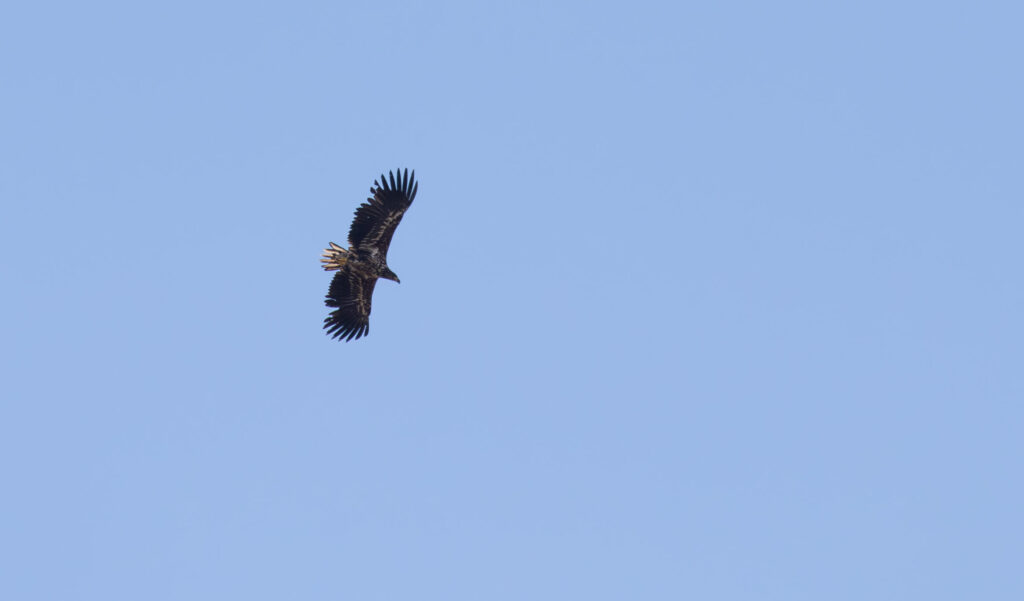
White-tailed Eagle – Committee Road, 20 May
Leaving the Committee Road we had not gone very far south when we saw a large raptor fairly low to our left and close to the road being mobbed by gulls and waders. An emergency stop followed! It was a sub adult Golden Eagle hunting over the fields and in turn it was being harried hard by breeding birds. It seemed untroubled as we had it in view for over five minutes before it drifted east. The views were spectacular, almost point blank. We could not ask for more.
After all this excitement we went searching for divers inland. This was the first quiet period of the day, and we drew a blank. Changing tack we headed west to Baleshare. We ended up at the beach and there we saw possibly 20 Great Northern Divers on the sea, in various plumage stages. Best of all however, were a pair of Black-throated Divers that popped up close in. They were actively fishing and were soon very distant in our scopes. Nonetheless we could see that they were in summer plumage. Hopefully, they will breed on the archipelago somewhere.
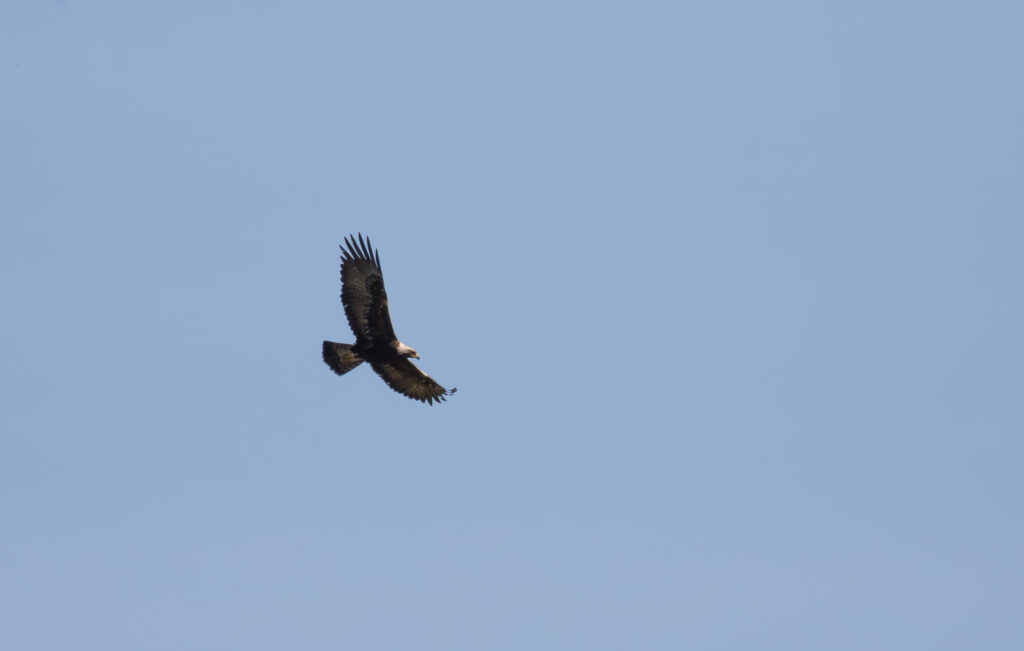
Golden Eagle – North Uist, 20 May
The day was drawing to a close, but whilst looking at wildflowers we saw a commotion among the waders and Rock Doves on the machair. Surely, there was a raptor about. Birds were flying everywhere. This included a flock of Ringed Plovers that held a tiny wader. It was probably a Little Stint, but the flock flew north and were not seen again. It took a while but eventually a Peregrine flew in front of us. He was the culprit.
The drive home yielded yet more excellent views of Short-eared Owls and Hen Harriers. So ended a day that included 9 White-tailed Eagles and 4 Golden Eagles. Not a bad haul at all.
One of the great joys of birding in the Outer Hebrides is the abundance of most species. Unlike in southern England there is not just one or two of a bird, but large numbers. So, it is with the Cuckoo. Over here it lives up to its name of Common Cuckoo. It starts at dawn, with us waking to birds calling around the hotel and then continues throughout the day with regular sightings and frequent calling birds. Take today. We started in South Glendale a small, sheltered valley at the bottom of South Uist. We took a walk along the valley as another beautiful day of weather unfolded. When we reached the last cottage, three Cuckoos suddenly flew into the overgrown garden. They perched on telegraph wires before calling and chasing each other. It looked like one female with two male suitors. Fantastic close views for us.
After Glendale, we explored the machair close by. Corncrakes were our quarry. We heard four at least before we managed to see one singing and then creeping along a shallow ditch containing irises. Good views after a lot of patience.
The rest of the machair and coast hereabouts was quiet, so we travelled to North Locheynort. This is a wonderful sheltered woodland site next to a sea loch. Whilst eating lunch we spotted two distant White-tailed Eagles and enjoyed very close views of a male Hen Harrier. The walk through the woodland was quiet under a hot sun, but we added Siskins and a Black Guillemot to our tally.
Our intention for the afternoon was to work the wader flocks on the rising tide. However, all the sites we tried were quiet and wader numbers were low. It seemed to us that many birds had probably continued their migration and gone north in the good weather. Our last action of the day was to rework The Range. The wader highlight here was a summer plumaged Black-tailed Godwit. The overall highlight was yet another White-tailed Eagle that went low over us, casting its shadow as it did. It seemed to be travelling without particular purpose, but then it suddenly turned and dived to the ground. It had caught something small, likely either a Lapwing chick or a young rabbit. Off it went, presumably to feed its own young. So ended a fairly quiet day.
WEDNESDAY 22nd MAY – Overcast but dry in strong NNW winds. 14C
A change in the weather today with strong winds coming into the islands. There was just enough west in it to make us think that migrant skuas might make an appearance. As a result, it was a trip north for us to North Uist.
After crossing the causeway from Benbecula we began scanning lochs and lochans for divers. It was not long before we found a Black-throated Diver. It was fairly distant and despite the early hour and the wind there was a bit of a haze, which made picking out plumage detail tricky. Nonetheless, there was no doubt about its identity, or the fact that it was an adult. As we left the diver a Short-eared Owl flew by. The Outer Hebrides is the place to see this charismatic bird. We have seen double figure counts of this species every day.
Next stop was Berneray. The wind was picking up now, but on the Borve machair we enjoyed our time working through a three-figure flock of small waders. A mix of Dunlin and Ringed Plovers. The highlight was a prolonged display flight by a Dunlin. It was hanging in the wind and singing strongly, a remarkable sight. Arctic Terns nesting on cultivated fields here and a smattering of Little Terns added to the scene. At Loch Brusda, it was fairly quiet until amazingly an Arctic Skua flew through and flushed a flock of Greylags.
Moving back on to the mainland the weather was closing in from the west, so we headed straight to Aird an Runair, eating lunch above the beach. We began our sea watch, but it was fairly slow going with only a flock of Bar-tailed Godwits and a few Fulmars to show for our efforts. We therefore turned our attention to the beach and refound a bright adult Little Stint reported earlier. Another highlight here was a male Ruff, this a ginger and black one. Looking incongruous feeding in the seaweed with the Dunlin and Turnstones.
Just then we received news that a couple of Pomarine Skuas had been seen going north. We hurried to the point and settled in. It was fairly birdy with Kittiwakes and Manx Shearwaters trickling by, but skuas were thin on the ground. Eventually, we picked out two distant pale-phase Poms. The views were tricky, but definitive. That turned out to be the first and last of them for us. The wind although strong did not have enough west in it to push the highly pelagic Poms and Long-tailed Skuas into viewing range. That is birding. Nevertheless, an enthralling session in an iconic location. We drove south and enjoyed the usual sightings of harriers and owls. So ended a fantastic week of good weather and excellent birding in one of the UK’s best locations.

Little Stint and Dunlin – Aird an Runair, 22 May


