

Over the years, whilst on Oriole Autumn trips to Shetland I have enjoyed several “pinch me” days. Those days when the weather is right, the cards fall your way and you see birds you never thought you would outside the pages of the Collins Bird Guide. I have seen several of a couple of the Shetland specials, Lanceolated Warbler and Pechora Pipit. I have only managed a single Pallas’s Grasshopper Warbler, but remarkably that sat in the open for its admirers. Three-star vagrants have included White’s, Siberian and Swainson’s Thrushes; Rose-breasted Grosbeak and a Veery at point blank range whilst a pod of Orcas swam into bay below us. However, October 1st 2026 might just be the “pinch me” day.
This year’s autumn trip had been dominated by westerly winds. American waders were plentiful with Buff-breasted and Baird’s Sandpipers to the fore. Nonetheless, the lack of east winds had severely limited eastern stragglers to Shetland. The one good eastern bird we had seen was a smart juvenile Citrine Wagtail expertly found by Jonny on Grutness beach. Eventually, constant westerlies became a bit of a drag and so we were pleased when a touch of south-east appeared in the forecast for 29th September to the 1st of October. Although seemingly short-range winds the 29th immediately produced with Yellow-browed Warblers, Redwings and Bramblings arriving. Best of all we found a smart, Red-breasted Flycatcher at Lower Voe. This was more like it.
The fly in the ointment was that whilst the forecast for 30th was for more south easterlies they were going to be accompanied by very strong winds and rain. Birding was not easy in that weather. It was hard to stand up, and the bushes were shaking so much it was next to impossible to see into them. However, the silver lining was that the 1st of October was set fair with just light south easterly winds. We went to bed knowing it was the last day of our trip but also hoping that some good birds, maybe even the “monster,” had arrived within the blow of the day before.
The morning started well in Sumburgh Hotel gardens with a showy Yellow-browed Warbler and a nice Common Redstart. We then moved on via a Slavonian Grebe at West Voe to the Pool of Virkie. The tide was out and there was a good spread of common waders, including a juvenile Curlew Sandpiper. By now news of an Olive-backed Pipit, several Barred Warblers and an Arctic Warbler had come through and we were keen to begin our own rarity hunting. As we began packing up our scopes Jonny’s sharp ears picked up the sharp ‘tick’ call of a bunting. As it flew over Sean expertly grabbed a shot. It was a Little Bunting, and we were on the scoreboard! Onwards!!
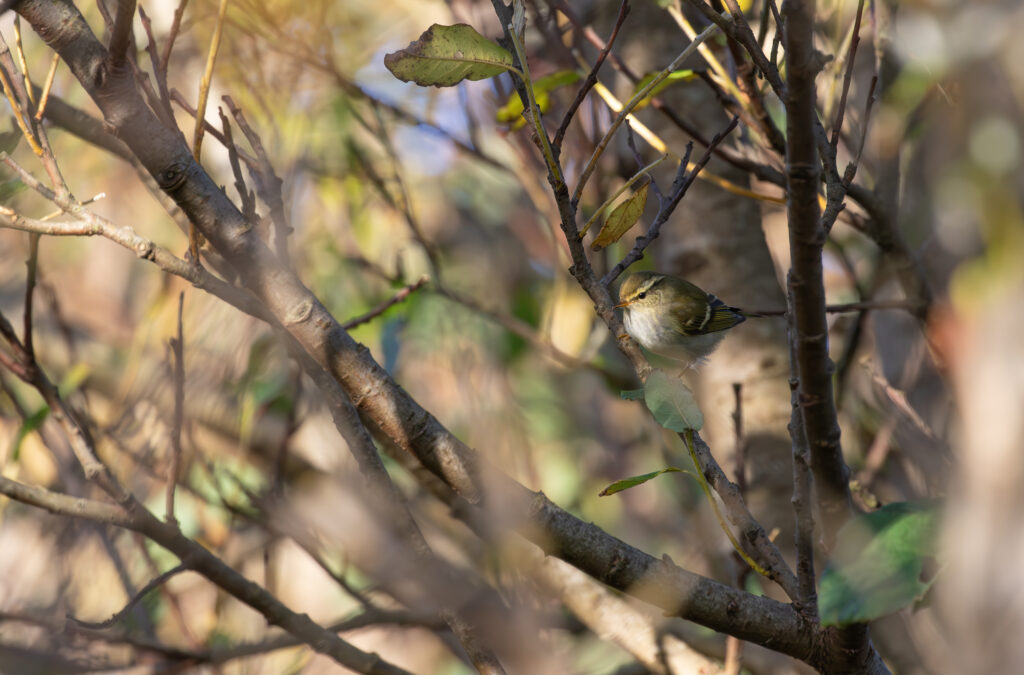
Yellow-browed Warbler
We tried to twitch an Olive-backed Pipit in Paul Harvey’s garden, but the limited viewing and a noisy cement mixer soon had us move on. A toilet stop was requested and some unseen force made us choose Quendale Mill Museum. We had decided to move on and bird Gulberwick and were just on our way out of Quendale when Jonny told me I had to turn around immediately. I knew it was something good but was unprepared for “Siberian Blue Robin, Hugh Harrop’s garden!!!”
Within two minutes we were opposite the drive to the garden. I dropped off Jonny and our clients and then had to drive back to Quendale Mill to park! This was agony, as it was half a mile down the road and I quietly feared missing the bird. I quickly parked and set off speed walking back up the hill towards the bird. By now birders were arriving, leaving cars less parked but more abandoned.Everyone was rushing up the road from the Mill. You always know it is serious when birders are running. Some of the portlier brethern appeared to be at risk of expiring, whilst some whip thin folk were impressively running ahead in wellingtons.
Eventually reaching the garden I was greeted with the news from our group that the bird had not been seen for 20 minutes or so since they arrived. Time dragged as more birders began to arrive. By now there must have been 150 birders gathered in a small space. Hugh Harrop assisted by a few locals began to try to tickle the bird up. A few brief views were had by a lucky minority who were standing in the right place but for the rest of us a frustrating wait went on. Just then someone whispered they had it on the ground in a gap in the vegetation. Sure enough the Robin emerged. It was face on. Upright and long legged, we could immediately see the eye-ring and scalloping on the breast. Otherwise, it looked fairly plain and colourless. However, it then turned through 180 degrees to head back into the vegetation. As it did a blue sheen was revealed that stretched from the nape to the tail and sharply contrasting with its brown wings. The amount of blue strongly suggested a first winter male. It was a moment difficult to describe, but my legs were genuinely shaking and I had goosebumps. A first for me whilst watching a bird. Over the next thirty minutes we enjoyed 3 or 4 further views of the Robin as it skulked in vegetation. The bird then disappeared and sadly was not seen again., much to the disappointment of later birders. However, by now the tension of the crowd had dissipated to be replaced by a low hum of contentment and smiles all round. The fifth record for Britain and we were there!
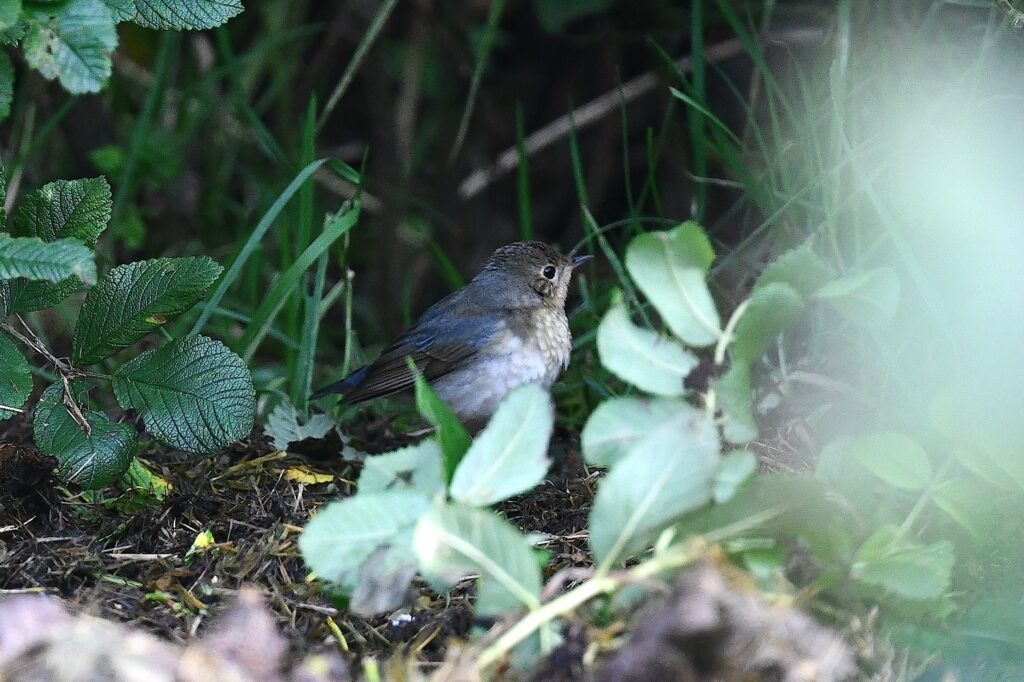
Siberian Blue Robin © Sean Greenway
Returning to the van we thought we could finally go to do our own birding. We drove north, stopping in Levenwick to have a late lunch. A birder who had arrived ten minutes before us had found a Siberian Stonechat, but there was no sign for us. Eating sandwiches Jonny received a call from Jack and Dan, two university buddies. They had an interesting phyollscopus warbler back in Quendale by the Mill. Superficially, it looked like a plain, dull Yellow-browed but maybe not. Two-barred Warbler was in the mix and the photos looked promising.
Back we went to Quendale. The warbler was in the small copse by the bridge. It soon showed and although the light was tricky, there was no doubt it was a Two-bar!! Not half a mile from the Robin another Siberian mega. The afternoon was sunny and warm, more Scilly type weather than Shetland and we watched the bird as if in a daze.

Two-barred Warbler
Time passed and as the ferry check-in was at 1730 we had to go. We just had time to work a couple of gardens in Gulberwick. A very showy Yellow-browed Warbler and a very unshowy Barred Warbler the reward for our efforts.
So ended our tour. A slow burn at first, but what a crescendo. October 1st, 2026, a ‘pinch me’ day indeed.
Nick Parsons, 3rd October,2026


