

FRIDAY 23RD AUGUST – Strong westerly winds and sunshine
The weather was rather interesting for our planned trip to Snettisham this morning for the big tide, with a system quickly crossing the country and pulling in temporarily gale-force winds after a pulse of rain had moved through in the early hours. We set off from base just before 7am with a packed breakfast and drove down to the reserved parking area at Snettisham, seeing our first flocks of waders whirling over The Wash in the wind as we went. Standing on the shore and scoping was not going to be possible so we opted to get bedded in at Rotary Hide and have breakfast and coffee in there while watching the tide race in. We could see squadrons of many hundreds of Oystercatchers and Black-tailed Godwits heading for the pits and huge flocks of Knot and the odd Grey Plover further out, but birding wasn’t easy in a packed hide and so once we’d seen off breakfast we headed on foot further down, to the South Screen.
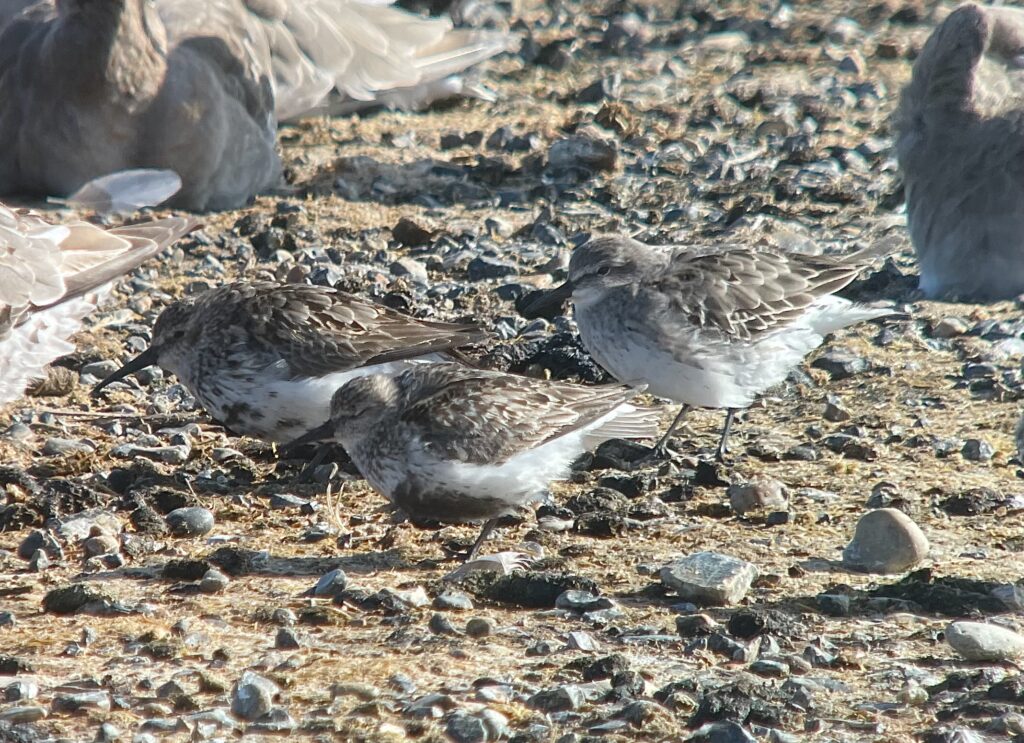
White-rumped Sandpiper, Snettisham 23rd August
Here we had the hide to ourselves and the light was perfect. Already masses of birds were on the islands outside the hide and we had brilliant views of them. There weren’t too many small waders but among the few Dunlin there was a lovely moulting adult Little Stint. A Green Sandpiper was close too and we could enjoy the spectacle of thousands of Knot spiralling down to the north of Shore Hide. While we were in the hide, the worst of the wind tightened its grip and it felt at times like the whole hide was going to blow away! It did ease as the sun came out though and so we took the chance to walk back to Shore Hide – Whimbrel and Wheatear being a couple of nice birds seen along the way.
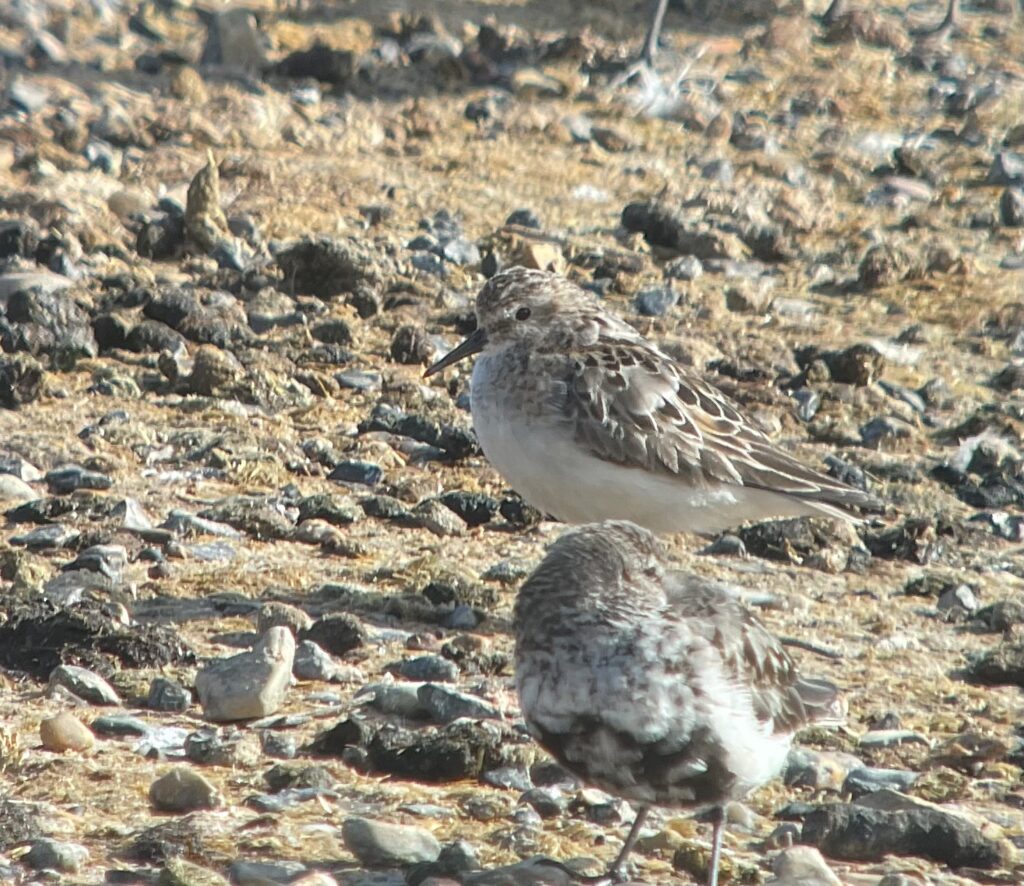
Little Stint
In Shore Hide, which was full to bursting, the adult White-rumped Sandpiper had been found and thankfully it was on the small island right outside the hide. This particular individual is not a small example by any means, and already being pretty much fully moulted to winter plumage made it very unobtrusive amongst the thong, since it spent the entire time tucked up asleep! A clean white belly with a few fine black flecks along the lower breast and onto the flanks were tell-tale signs even in these views though, and eventually it did the right thing and woke up and even had a run around. The crisp white supercilium (very distinct in front of the eye, quite short and fine-tipped, droopy bill with brownish base to lower mandible and even a flash of the white rump could be seen. The same Little Stint was scurrying about too and the sea of Knot, moving as one seething mass, was quite a sight to see.
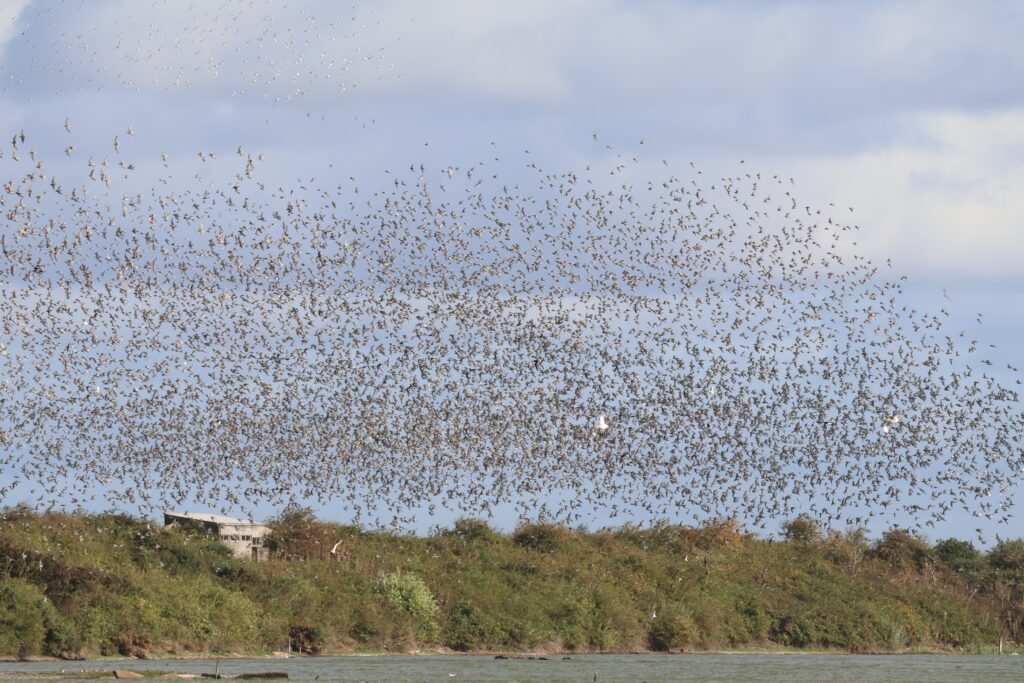
Waders over the pits at Snettisham
At 10am we broke away and headed back to the van, as we now needed to return to the hotel for check out and coffee before making another birding stop to Holkham. This option gave us some shelter from the weather, and also a chance for one or two new birds for the trip list in the woodland. Treecreeper and Coal Tit were added on the walk through the meals, where several Chiffchaff were also seen and among a crop of commoner butterflies, we had superb views of a Purple Hairstreak nectaring on the final blooms of Hemp Agrimony. At the new Joe Jordan hide, we had lunch overlooking the new scrape which held four Green Sandpipers, two Common Sandpipers, a Greenshank, a few Ruff and Snipe. Great White Egret was also seen here. Back at Lady Anne’s Drive, there were at least ten Cattle Egrets with the livestock there, a real sign of the times and on the back of their best ever breeding season on the reserve here. That wrapped things up for us and we headed back to the hotel to collect cars so folk could get away ahead of the bank holiday traffic.
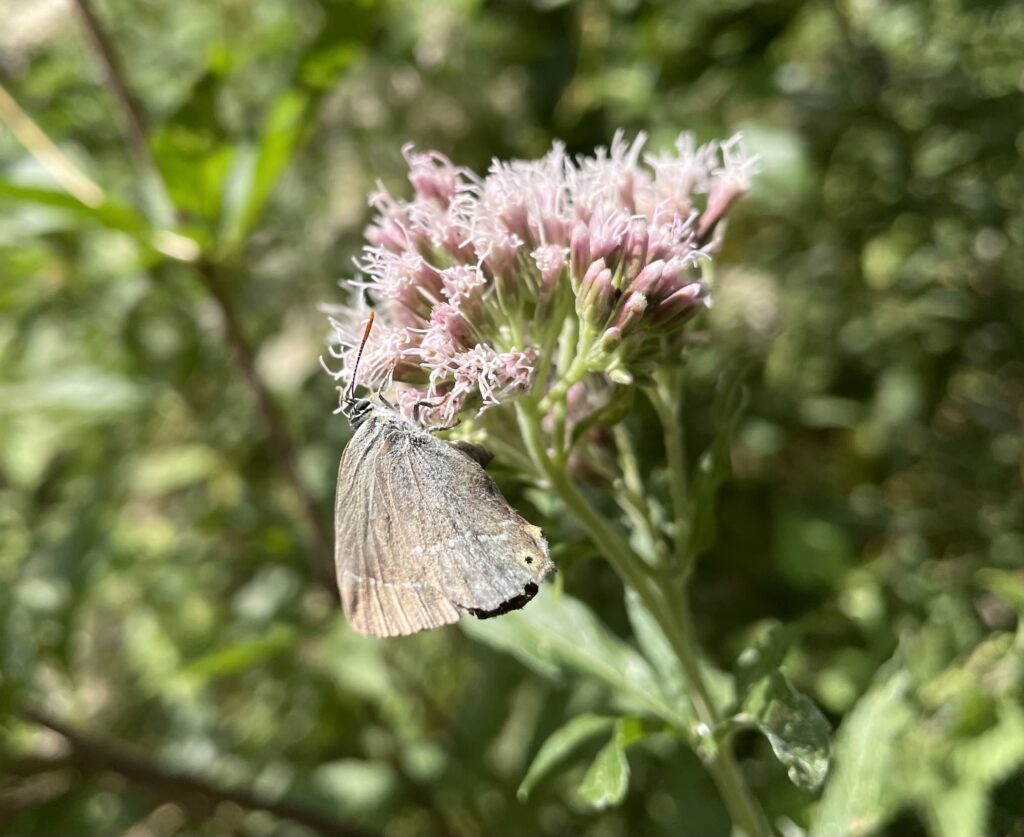
Purple Hairstreak
THURSDAY 22ND AUGUST – Strong westerly winds and sunny spells
We headed around to Lincolnshire today to pay a visit to the bird-filled Frampton marsh. A bit of excitement came through at first knockings as a Baird’s Sandpiper had been photographed last night from the seawall and it was now being looked for on the rising tide at dawn. Well before we had arrived on site the bird had been re-found and we could see a small gaggle of observers hunkered down on the windswept seawall – unfortunately though they had not seen the bird again since the original five-minute sighting and it appeared that it had already flown back out to The Wash. Nevertheless a feast of small waders was spread out before us, though the wind was so strong that it was not possible to stand and use a scope and we had to improvise by sitting down below the top of the bank and trying to share the scope views around as best as we could. Two juvenile Little Stints and two adult Curlew Sandpipers were picked out, amongst a horde of Dunlin and Ringed Plover. The latter were already well-moulted grey birds with just a few odd flecks of red on the belly. Better still another small wader moved into view along the sandy shore – a juvenile Temminck’s Stint. This bird had been around on and off for a few days, and showed really well for us before flying off and disappearing into the marsh. A juvenile Curlew Sandpiper then appeared and joined the adults – a nice comparison of the two plumages.
Back to the Visitor Centre now for coffee and toilets, and a brief respite from the wind. We then headed on around Reedbed pool which was full of Black-tailed Godwit, Ruff and Snipe.
We headed to Reedbed hide which gave us good views of the big godwit flocks, and a roosting party of Spoonbills. Another or the same juv Curlew Sandpiper appeared, and a Green Sandpiper was seen distantly at the back. Weighing up our options now, we felt a return to the seawall given the conditions was not going to be much fun, so we hit the road and headed back through King’s Lynn and round to Titchwell.
The freshmarsh was busy with birds, and Island Hide was the undoubted best spot today. Dunlin and Ruff were feeding really close to the hide in perfect light, and there was the usual assortment of gulls, wildfowl and the odd Spoonbill about too. A Bearded Tit flew past the hide and then showed along the base of the reeds – actually this sheltered edge was productive as we also had views of both Reed Warbler and Sedge Warbler, while a Water Rail weaved in and out of the stems in amongst Snipe. Walking up to the beach, it was again very windswept but we managed a lovely summery Bar-tailed Godwit, several Sanderling, Turnstone and a couple of Great Crested Grebe. That pretty much rounded off our day and we headed back to Briarfields in time for tea!
WEDNESDAY 21ST AUGUST – Sunny day in fresh SW winds, 18C
The first of a three-day foray for shorebirds on the Norfolk coast was a successful one, with a good spread of the target family (15 spp of waders seen today) and a nice selection of other coastal birds to boot. We spent most of the day east of our Briarfields base, exploring around the environs of the famous Cley reserve, but with a huge marsh tide on early doors, we first called in at Stiffkey Fen on our way East to see what had been pushed in to roost there on the high water. Chiffchaff and Bullfinch were noted along the overgrown path down beside the River Stiffkey, and once on the seawall we could soon see the expected flock of Spoonbills resting at the back of the fen – 48 birds in total, a mix of adults and juveniles recently fledged from the Holkham colony. There were probably around 200 Redshank and at least 30 Greenshank roosting too, plus five Green Sandpipers and a smattering of Black-tailed Godwit and Ruff. The biggest surprise of the morning though, was an Otter which appeared at the reed edge flushing out all the ducks before weaving its way in and out along the edge and then breaking cover to run across the main island much to the bemusement of the geese and Spoonbills who all stood alert and watched it run past! Out in Blakeney harbour, we could see a few Grey Seals hauled out on Far Point, but we were rather glad we weren’t bobbing around among the white horses like the seal boats and their punters, in the very fresh wind!
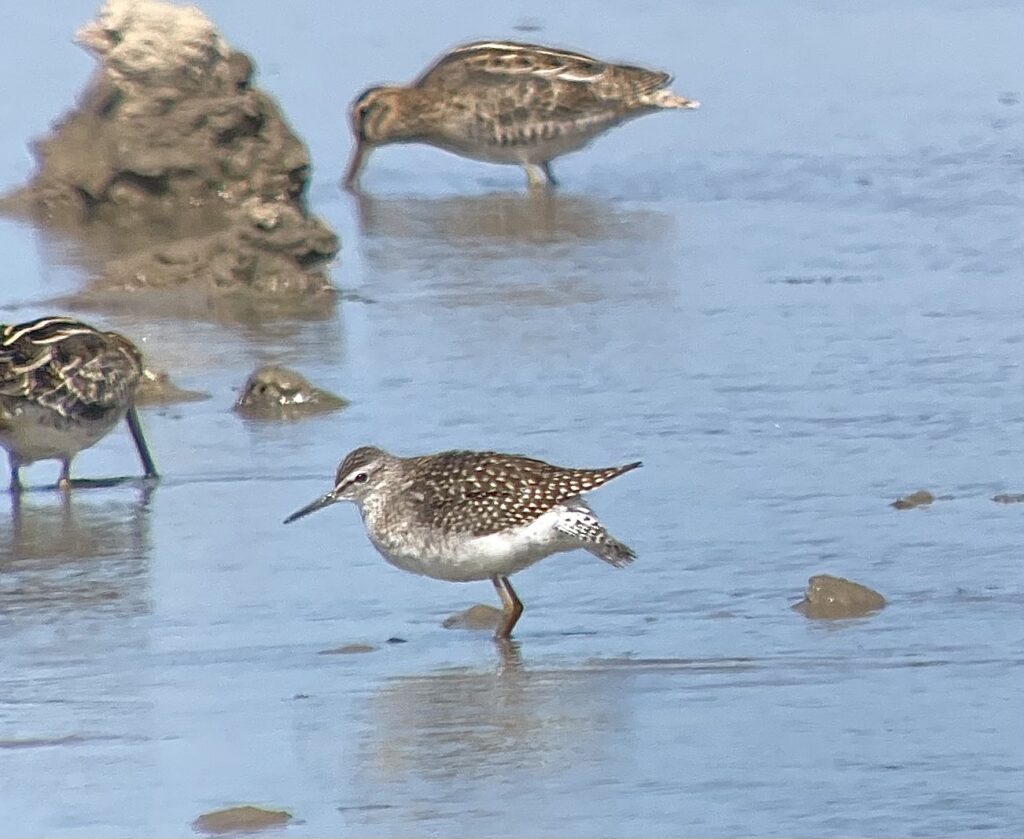
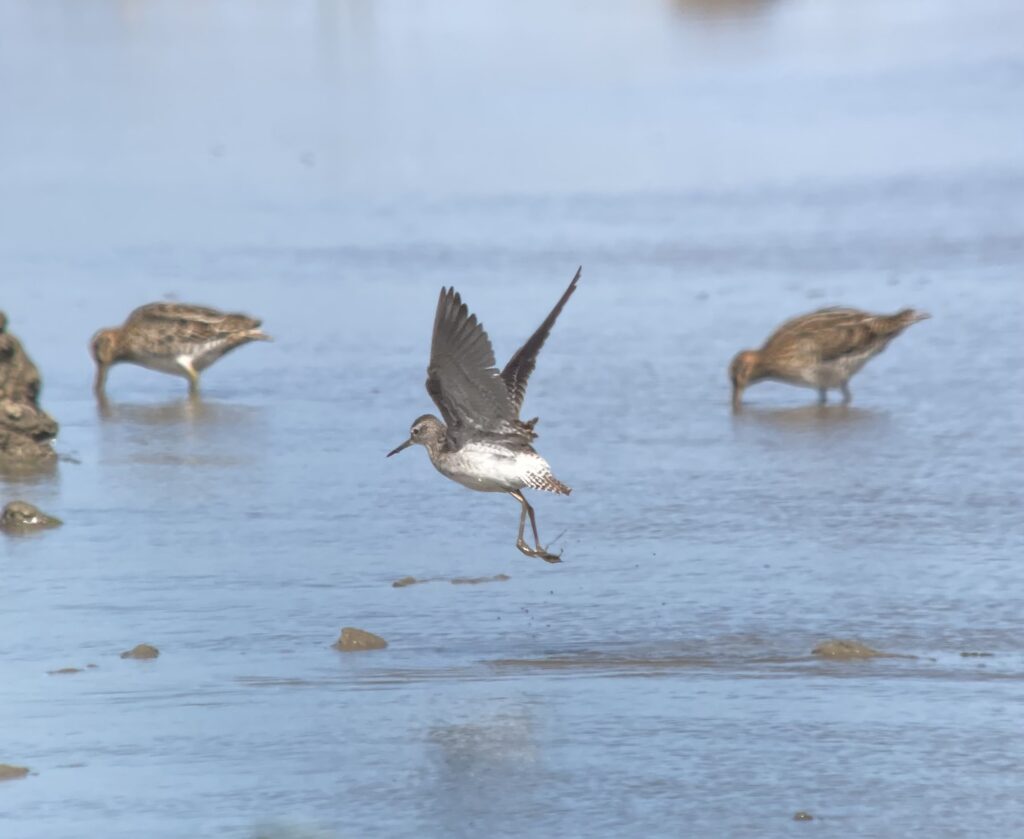
Wood Sandpiper at Cley, 21st August
Onwards to Cley next and after calling at the Visitor Centre we walked out to the central hides. Simmond’s Scrape is being dried out for maintenance work but still hosted a few Little-ringed Plovers, and at least three Green Sandpipers. A smart juvenile Ruff right in front of the hide gave us a good chance to catch up with the relative subtleties of this often misidentified wader! A slightly odd sight here were two small raptors sitting on the dried out island at the back of the pool – they were both adult Hobbies! Moving into Teal Hide (which was rather full!) we enjoyed more Ruffs, another 3 Green Sandpipers, Common Sandpiper, and several Black-tailed Godwits and Avocet. Six Dunlin dropped in and right at the back of the scrape, we picked out a Wood Sandpiper – very distant in the heat haze but just about identifiable. Hoping for better views we decided to walk round to Bishop’s Hide where we had the light behind us – this proved a good move as the Wood Sandpiper was very close to the hide and showing beautifully. A fresh juvenile, we were able to admire its gold-spangled upperparts and yellowish legs. Four fresh juv islandica Black-tailed Godwits also appeared and landed by the hide, and a young Marsh Harrier gave excellent views sitting at the back of the pool. Just as we were about to pack up and head back for lunch, we were treated to a real bonus as a Bittern leapt up from the grazing marsh and did a beautiful long flight right across in front of us – superb!
After lunch, we decided to head a little further east along the coast to Kelling and check out the Water Meadows – a couple of Garganey had been here in recent days but it was also a welcome respite from the wind! Viewing the pool wasn’t that easy with the overgrown hedges and reeds, and several cows that made better doors than windows! Nevertheless we soon found the two Garganey, most probably juveniles but we never saw the open wing. Subtle birds indeed, but eventually we had good views of their distinctive head pattern and large bill.
We ended the day back at Cley, with a walk down East Bank. The Serpentine was very quiet but a juvenile Cattle Egret flew past us over the bank as we walked down and Arnold’s Marsh held a few Sandwich Terns and a couple of Curlew. It was already 4pm by now so time for just one short stop on the way back to base, at Wells North Point. The west pool here is now dry while the eastern one is full of water! So subsequently there wasn’t much to see other than a load of Barnacle Geese and three more Spoonbills. A good first day!


