

BIRD WATCHING MAGAZINE READER HOLIDAY – 8TH – 12TH MAY 2024
WEDNESDAY 8TH MAY – Fine and sunny with light winds, 18C
The group met at Briarfields at Titchwell this afternoon at 3pm ready for a 3.30pm birding excursion. Nick and Ashley had just found a pair of White Storks on their drive over the meet the group and so drinks were quickly abandoned and we rushed back to the spot, which was thankfully less than two miles away at Choseley. The storks had circled in high and spotted a tractor ploughing close to the road south of the drying barns, and duly dropped in to feed behind the plough with all the gulls! We had superb close views of them with the light behind us, a slightly surreal experience! As it turns out, one of the birds, which was ringed at Knepp and part of their rewilding project, recently went to Spain and seemingly returned paired to the unringed bird it is now with – so a wild one. They had been in east Norfolk up until the previous day, and seen over Cley in the morning. We carried on checking a few fields around Choseley, picking up singing Common Whitethroat, Yellowhammer and a few Red Kites, plus Roe, Chinese Water Deer and Muntjac.
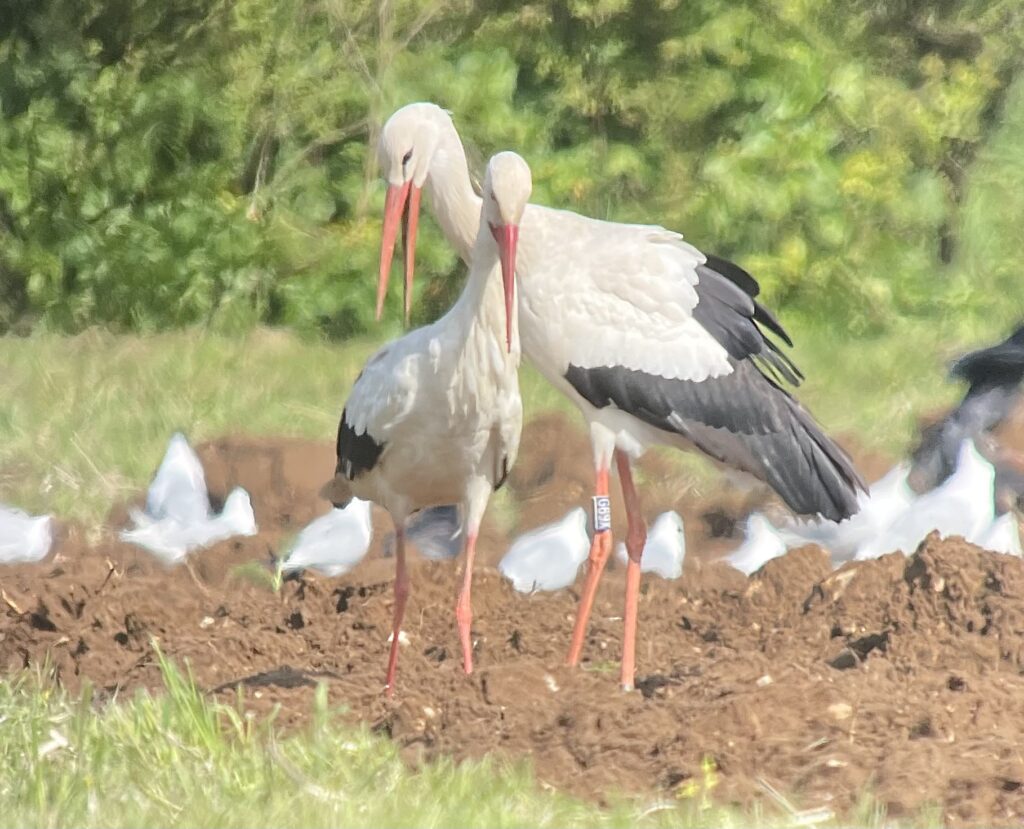
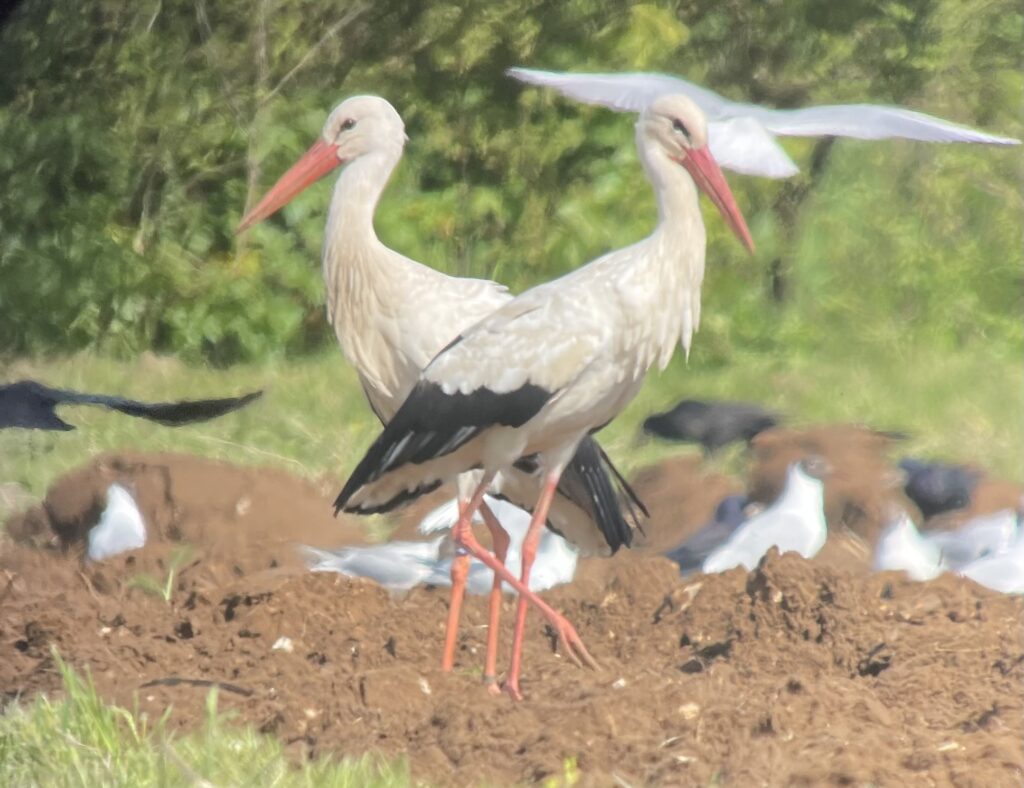
White Storks (Knepp-ringed male and unringed female) at Choseley, 8th May

White Stork, Choseley, 8th May
Titchwell reserve was our port of call for the remainder of the evening, and in the sunny calm weather there was plenty to see. The scrub and reedbed resounded to the songs of Chiffchaff, Blackcap, Sedge Warbler, Reed Warbler and Cetti’s Warbler while the reedbed pool hosted several Pochard, Great Crested Grebe and Little Grebe. Marsh Harriers are always a constant feature here at this time of year, and were causing mayhem as they overflew the main freshmarsh. A few waders were seen here, with two pairs of displaying Little-ringed Plovers, two Common Sands, Ringed Plover and best of all three Ruff including two males (one black, one ginger). The black-ruffed bird went into full display, crouching down low to the water and ‘inflating’ his Ruff while dancing around the female and subsequently chasing off the other male. A splendid sight! Round at Patsy’s Screen we finished with excellent views of Cuckoo and a brief view of a Lesser Whitethroat to round off a 60-species afternoon!
THURSDAY 9TH MAY – Fine and sunny in light SE winds, 20C
A superb days birding today on the North Norfolk coast saw us head to Burnham Overy Staithe for the morning, walking out along whincover track to the seawall and on to the dunes. As we walked out, we saw our first Common Whitethroats and Yellowhammers of the day and also had a good perched scope view of a Lesser Whitethroat delivering its tinny rattle from the top of a flowering hawthorn. Once we reached the more open grazing marshes a Cattle Egret flew east over track ahead of us, and the first of several Spoonbills, on a feeding sortie from the nearby colony at Holkham, passed over our heads. Sedge Warblers were really common all along the walk and we had lots of good views of displaying birds, and even a Cetti’s Warbler gave us a glimpse as it belted out its song before flying along a ditch. Once up on the seawall itself, we were treated to an incredible sight as a Marsh Harrier flushed two Bitterns out of the reeds and they flew low over the heads of five Great White Egrets before dropping out of view. We heard some booming during the morning too, which was great to hear.
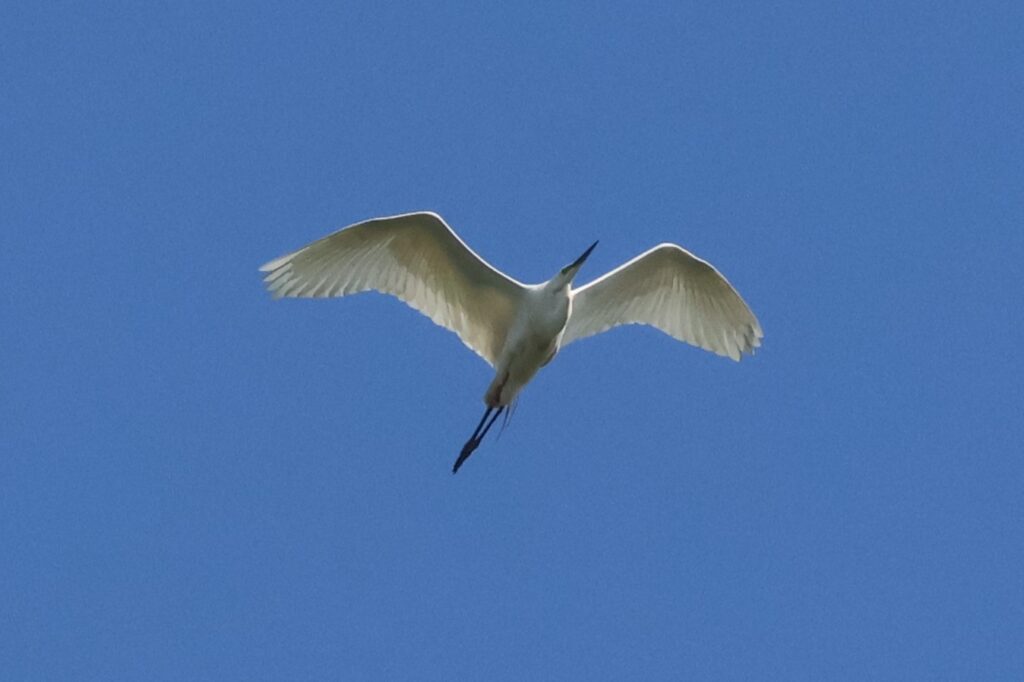
Great White Egret
Further along the seawall we checked the saltmarsh on the west side and with a big tide, several waders were roosting there. Eleven Grey Plovers were mostly in spanking summer plumage but perhaps even better was a pristine Red Knot amongst them too – not a plumage folk get to see every day. An equally smart Turnstone wandered into view too, and a few Brent Geese were lingering on the saltmarsh. The final stretch of seawall before the bushes produced great fly-by views of two Cuckoos which flew from the dunes and came right past us. The boardwalk bushes held another Lesser Whitethroat and two migrant Willow Warblers, indicating that perhaps there were one or two passerine migrants moving in the lovely warm south-easterly breeze. With this in mind we headed further east through the dune system, and were rewarded with good views of a superb male Redstart which flicked out of the bushes by the path and eventually showed really well for us. Retracing our steps, we added fine views of a Wood Sandpiper on the pools just south-east of the boardwalk, close enough to see its lovely white-spotted upperparts and yellow legs. The walk back produced a nice sighting of a Whimbrel beside the path, and we eventually reached the van again some four hours after setting off on our walk. Lunchtime!
Holkham was our venue for lunch, in the sunshine on the picnic tables at the Lookout. We added a brace of Grey Partridge by Lady Anne’s Drive as well, before moving along the coast eastwards to Wells North Point. It was quiet here with the high water levels, with only a flock of Black-tailed Godwits of real note, so we continued straight on to Stiffkey. The Glossy Ibis which had been present there since November had maybe finally chosen today to move on as we didn’t see it (and one had gone east along the coast earlier in the day) but we did see a smart summer-plumaged Green Sandpiper on the floods there instead. One or two passage waders were obviously moving as three Temminck’s Stints were then reported from Cley, and as we were heading that way anyway we decided to go straight to the hides where they had been seen. A brisk walk out along the boardwalk to Dauke’s Hide soon had us watching the three diminutive waders, shuffling around the muddy edges of the islands in typical fashion. This really was a smash and grab visit as we wanted time to just roll the dice once more before the end of the day and look for a Purple Heron at nearby Blakeney Freshmarsh. Sadly the bird didn’t oblige for us, but it had been a good day anyway!
FRIDAY 10TH MAY – Fine and sunny with light SE winds, 21C
Today we made the long trip out east as we had a specially arranged boat trip on Hickling Broad with the Norfolk Wildlife Trust. We arrived at the reserve car park (where some of the group got good views of a Garden Warbler singing) about 1015 and then made our way across the reserve to the boat jetty, where we met up with our local guide John who would be taking us around the reserve. It was a beautiful day to be out and the song of the Willow Warbler, which is thankfully still commonplace here, could be heard all along the way. Once on the water, Marsh Harriers became a constant companion and we had superb close views of them, with the ‘pinging’ of Bearded Tits and the cries of Common Terns providing the backdrop. We nosed through the reeds to Rush Hills Hide and while the scrape here holds far too much water for the time of year (a legacy of the highest ever water levels on the reserve here in winter) we did add a young drake Goldeneye which was a surprise, and a Greenshank circled low calling before continuing on its way. Overhead, we had superb views of Hobby once back in the boat, with two regularly hawking right above us and even heard calling at one point.
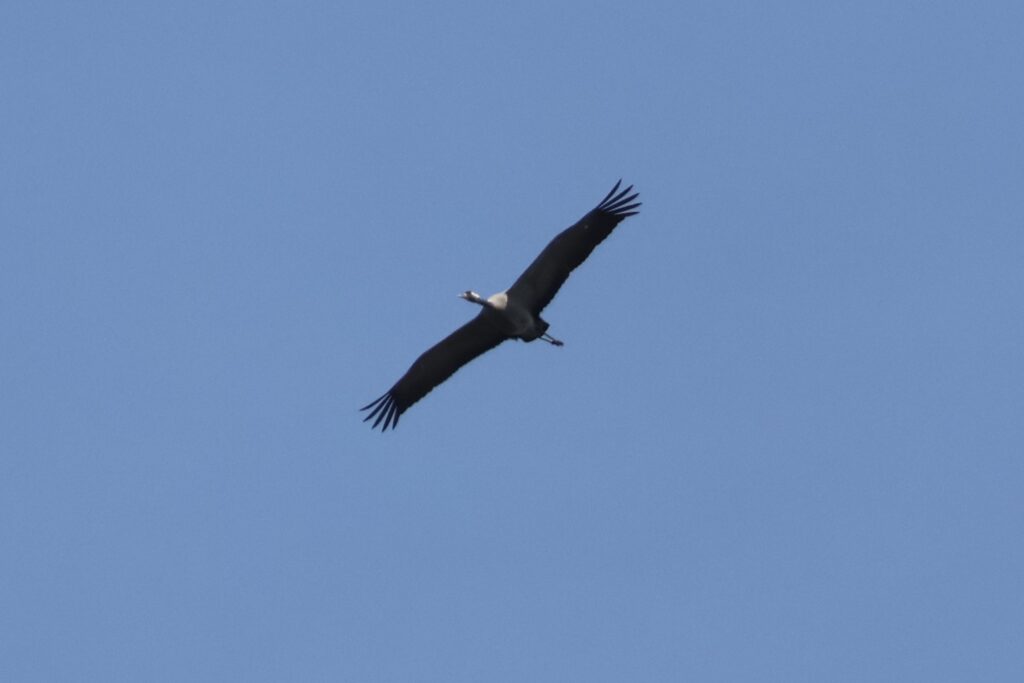
Common Crane – good views today at Hickling
Continuing through the narrow cut along towards Heigham Holmes, we moored by the Weaver’s Way footpath and then entered the private woodland to scale the 60ft metal tree tower which affords spectacular views across the whole reserve and out to the coast. We saw eight Cranes from here, flying in the distance, and heard lots of bugling of birds in the reedbeds too. Hobby was seen again, Cuckoo was calling and we were just enjoying drinking in the views in the beautiful weather. Retracing our route we had lovely close views of nesting Great Crested Grebes in the emerging beds of mares tail, and eventually some good views of Bearded Tits too. All in all a very enjoyable trip and before we knew it, it was lunchtime!
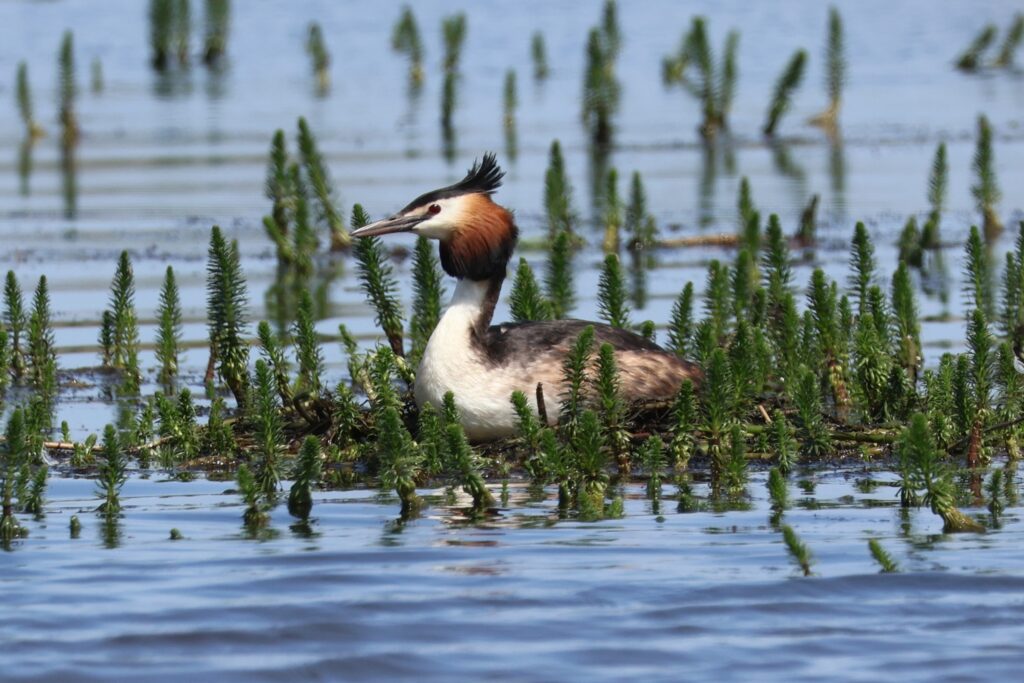
Great Crested Grebe in Mares Tail, a classic spring Broadland scene
We continued our exploration of the reserve on foot after lunch, checking the freshwater scrapes on Brendan’s Marsh. It was really quiet here, and we didn’t see much other than a few common waterbirds, Great White Egret, a pair of Mediterranean Gulls and almost constantly booming Bittern. We decided to walk round to Stubb’s Mill viewpoint, and from here we had good views of a pair of Cranes on the ground in the meadow, with another in flight in the distance. Back to the reserve centre then, before embarking on the long drive back towards base. We wanted to end the day by checking a couple of farmland sites and at the second of these we found two Corn Buntings, with one delivering its jangling song from the top of a hawthorn hedge. A slow afternoon but not entirely surprising given the heat and clear weather.
SATURDAY 11TH MAY – Fine and sunny in light SE winds, 20C
A day down in Thetford Forest and the Brecks today saw us heading into the fringes of North-west Suffolk for our first stop at a regular haunt of Nightingale. We could hear our first bird singing close to the car park, but first wanted to scan the adjacent grassy breck before the heat haze picked up. Our quarry here would be Stone Curlew, and we soon found a pair though they were clearly highly agitated by a herd of cattle heading through the area where they clearly had a nest. One inquisitive calf got too close to the male Stone Curlew, which responded with a threat display, opening its wings and flashing its striking black and white wingtip pattern while lifting its head high and repeatedly dashing straight at the rather perplexed looking animal! The Stone Curlew was successful in diverting the herd around their patch and presumably saved the nest from being trampled – amazing behaviour to watch! We then got back on track with our Nightingale quest, heading up to an area of hawthorn, oak and elder scrub with lush nettle undergrowth. We could hear a bird belting out its incredible song not that far from the path, and soon found him perched right out in full view on a dead branch. Thankfully the bird obliged long enough for two goes each on the scope – job done! Garden Warbler was also prolific at this super location and we heard four differed birds singing, eventually getting really good views of one. Another four signing Nightingales took the tally to five but we didn’t manage any more sightings.


Two drab birds with fantastic songs – Nightingale (top) and Garden Warbler in the Brecks
Our plan next was to head into the forest to check one of the clearings but as we started travelling we began to get news that a Black Tern movement was taking place on a broad front across the whole country, with several small flocks already noted in Norfolk and Suffolk. They were being drifted across the North Sea on the easterly breeze (which was also rolling fog up at the coast) and so we decided to swing by Lakenheath Fen to check Hockwold Washes, the most obvious open water body in the area. We climbed the bank to overview the washland and it was immediately apparent that the area was a tern-free zone. We hung on, scanning, for twenty minutes or so and in the process picked up good views of a smart drake Garganey, plus a Great White Egret, two Hobby and a close fly-by Cuckoo. No Black Terns though, so we headed back to the car park for a relaxed lunch on one of the picnic tables in the shade. We were just clearing up ready to go when we heard a shout via the Visitor Centre – Black Terns on the Washland! Well we’d had the right idea, just half an hour early! We dashed back up there in time to see two superb Black Terns quartering up and down the wash, and occasionally towering high into the air after insects. Brilliant birds to see and a classic early May spectacle.
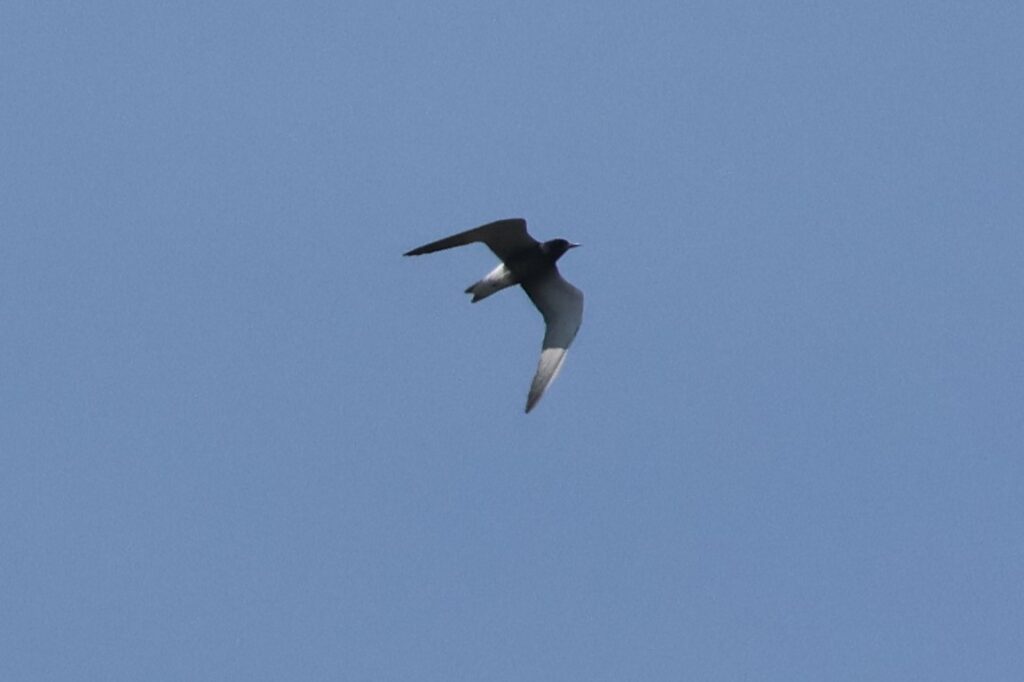
Black Terns over Hockwold Washes, 11th May
The rest of the afternoon was rather hot and sultry, but we wanted to try one of the forest rides to look for Tree Pipit and Woodlark next. Walking in along one of the forestry commission fire breaks, we arrived to the song of the Tree Pipit and went on to have good views of at least four birds. No Woodlarks around, but we did add yet another brace of Hobbies, so we were really doing well for them. We had time on the way back to check one more site and here we did flush a Woodlark off the side of the road, but it flew into cover and we didn’t manage to find it again. We still had an hours drive back to base so we had a slightly earlier finish after the last couple of days exertions, arriving back there around 1730.
SUNDAY 12TH MAY – Fine and sunny with a cool east breeze, 20C
Our final day was spent again on the North Norfolk coast, starting just east of our base at Burnham Norton. We walked out from the car park to the seawall, noting lots of singing Sedge Warblers performing their parachuting displays, and a nice view of a Cuckoo calling from the very top of an old oak tree. The sea wall gave us good views of the saltmarsh over the high tide, and several terns were splash-diving into the channels here including several close Little Terns. Among the Common Terns, we also had brief views of a single Arctic Tern, with its swallow-like long streamers, white upperwing and dusky body – a scarce bird here. There were still a few small flocks of Brent Geese out on the marsh, but the wintering Red-breasted Goose that had been with them now seemed to be gone. The rest of the circular walk didn’t produce any hoped-for waders, due to the extremely high water levels on all the pools, so a pair of Stonechats and a lingering Pink-footed Goose were about the best of it.
Next we headed east to Wells, and made a quick stop at North Point pools as a pair of Temminck’s Stints had been seen there early morning. We managed to find one, buried in the grass at the back of the west pool, but extremely distant difficult to see in the haze – also not to be confused in those conditions with the two larger Common Sandpipers present! The Blakeney Freshes Purple Heron had eluded us on our previous visit so we headed there next for another try. Sadly, it hadn’t been seen for two hours on our arrival and after giving it a further hour ourselves, we had to accept defeat again. One of those ones where you knew it would show eventually, but just how long to wait?!
Cley East Bank provided our trip finale, and a nice collection of shorebirds were on offer here. At this time of year, we see the smaller and darker-backed tundrae race of Common Ringed Plover passing through, often in the company of Dunlin. Five were on The Serpentine, with the much larger Greenshank striding amongst them. On Arnold’s Marsh, more waders included Turnstone, Knot, Bar-tailed Godwit and Grey Plover, plus our first Sandwich Terns of the trip. From here we wrapped things up, heading back to Briarefields for about 3.30pm for everyone to get on their way after an enjoyable few days.


